About Scoliopus bigelovii Torr.
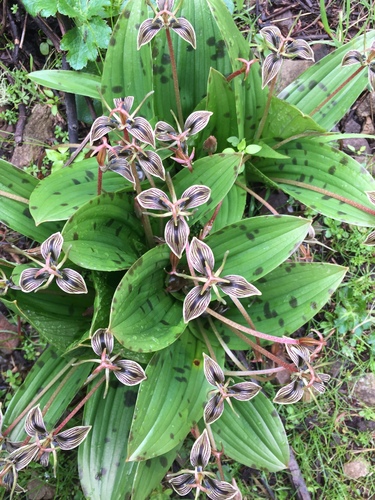
Scoliopus bigelovii Torr. is a herbaceous perennial plant, one of the two species that make up the genus Scoliopus. It grows from a rhizome and a short segment of underground stem. It produces above-ground foliage that most often consists of two large leaves, each reaching up to 24 cm long by 10 cm wide, though individuals may sometimes have 3 or 4 leaves. The leaves have multiple longitudinal veins, are green in color, and feature darker green or purplish mottling. Its inflorescence forms an umbel, but the main peduncle is mostly located underground. Three to 12 individual flower-bearing pedicels rise above the soil surface, giving the appearance of separate flowers. Each flower has three flat, spreading, pointed oval to lance-shaped sepals, plus three narrower, linear or fingerlike petals. Sepals are pale or greenish, marked with dark purple stripes or streaks, and the flower produces a disagreeable scent. Three short stamens sit at the base of the sepals, and the style has three long, often curved branches. The plant produces a capsule fruit. As the fruit matures, the supporting pedicel twists or droops to bring the fruit into contact with the ground substrate. S. bigelovii is an understory species that grows in shaded redwood (Sequoia sempervirens) forest habitat along the California coast. Other tree species commonly associated with its microhabitat include tanoak (Notholithocarpus densiflorus), bigleaf maple (Acer macrophylum), California bay laurel (Umbellularia californica), and Douglas fir (Pseudotsuga menziesii). A 2018 study by Hanover and Russell found that S. bigelovii is especially sensitive to forest management activities such as logging and selective harvesting, with documented population declines in disturbed areas. Ecologically, this species blooms in January and February, and its flowers are pollinated by fungus gnats from the genera Mycetophilla, Sciara, and Corynoptera. Its seeds mature and are dispersed in May and June by multiple ant species: Formica fusca, Formica rufibaris, and Aphaenogaster subterranea.