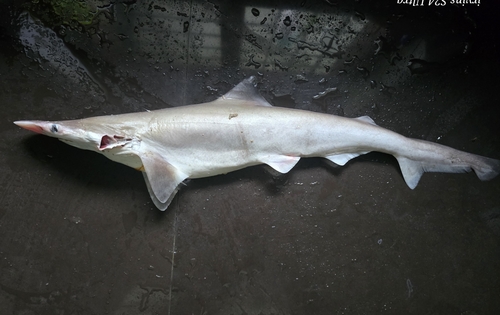
About Scoliodon laticaudus Müller & Henle, 1838
Scoliodon laticaudus, commonly called the spadenose shark, is a small, stocky shark species. It has a broad head with a characteristic, strongly flattened, trowel-shaped snout. Its eyes and nostrils are small, the corners of its mouth lie well behind the eyes, and these mouth corners only have poorly developed furrows. There are 25–33 tooth rows in its upper jaw and 24–34 tooth rows in its lower jaw; each individual tooth has a single slender, blade-like, oblique cusp that lacks serrations. The first dorsal fin sits closer to the pelvic fins than to the pectoral fins, which are very short and broad. The second dorsal fin is much smaller than the anal fin, and no ridge runs between the two dorsal fins. The spadenose shark has a bronze-gray back and a white belly, its fins are uniformly colored but may be darker than its body. The maximum confirmed length of this species is 74 cm (29 in), though unconfirmed reports note individuals reaching up to 1.2 m (3.9 ft). The spadenose shark occurs in the western Indo-Pacific, ranging from Tanzania through South and Southeast Asia, east as far as Java and Borneo, and north as far as Taiwan and Japan. It most commonly lives close to the coast at depths of 10–13 m (33–43 ft), often near rocky bottoms. It is regularly reported from the lower stretches of rivers in Malaysia, Sumatra, and Borneo, but it is unclear if this species can tolerate fresh water, as no salinity data from these sites has been collected. This species is abundant in many regions, and often forms large schools. It feeds primarily on small bony fishes including anchovies, codlets, burrowing gobies, and Bombay ducks. It will also sometimes consume shrimp, crabs, cuttlefish, and stomatopods. Documented parasites of the spadenose shark include the tapeworm Ruhnkecestus latipi and larvae of ascaridid roundworms. The spadenose shark has the most advanced form of placental viviparity documented in fish, when measured by the complexity of the placental connection and the weight difference between an egg and a newborn. Newly ovulated eggs are only 1 mm (0.039 in) in diameter, and developing embryos become dependent on their mother for nutrition when they reach just 3 mm (0.12 in) in length. The placental stalk develops from the yolk sac, has an unusual columnar structure, and is covered in many long appendiculae that support an extensive capillary network, creating a large surface area for gas exchange. Placental tissue contacts the uterine wall in a unique structure called the "trophonematal cup", where nutrients pass from the mother's bloodstream into the placenta. Females likely mate at least once per year, and breeding occurs year-round. Gestation lasts 5–6 months, and newborn pups measure 12–15 cm (4.7–5.9 in) long. Litters contain between 6 and 18 young. Males reach sexual maturity at 24–36 cm (9.4–14.2 in) in length, while females mature at 33–35 cm (13–14 in) in length. Estimates of age at maturity range from 6 months to 2 years. Maximum lifespan is thought to be 5 years for males and 6 years for females.