About Sclerurus scansor (Menetries, 1835)
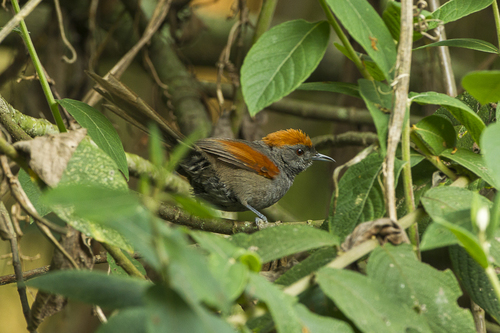
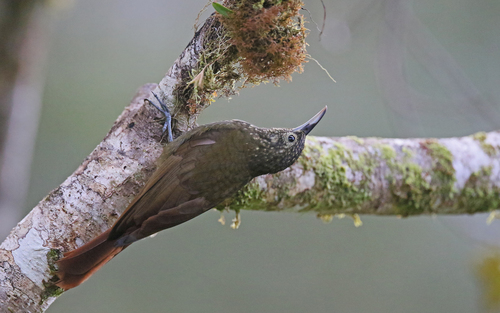
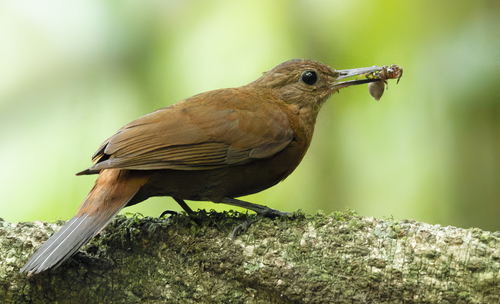
The rufous-breasted leaftosser, with scientific name Sclerurus scansor (Menetries, 1835), is one of the larger species in the genus Sclerurus. It measures 17.5 to 20.1 cm (6.9 to 7.9 in) long and weighs 30 to 41 g (1.1 to 1.4 oz). Males and females have identical plumage. The nominate subspecies has a dark brownish face with a somewhat grizzled look. Its crown is very dark brown with blackish scalloping, its back is rich dark brown, its rump is bright chestnut, and its uppertail coverts are chestnut with reddish brown tips. Its wings are dark reddish brown, and its tail is sooty blackish with faint red-brown tones. Its throat is pale grayish white with dusky scaling, and its upper breast is dull rufescent brown with a scaly appearance. It has a wide ochraceous chestnut band across the middle of its breast. Its belly and flanks are dark olivaceous brown with chestnut tones, and its undertail coverts are similar with richer chestnut coloring. Its iris is dark brown, its maxilla is black, its mandible is black with a whitish base, and its legs and feet are blackish brown. Juveniles look similar to adults but are darker overall. Subspecies S. s. cearensis is slightly smaller than the nominate subspecies. It has a clear white unscaled throat, and its upperparts and underparts are slightly brighter than those of the nominate. The nominate subspecies of the rufous-breasted leaftosser is distributed from the Brazilian states of Mato Grosso, Goiás, and Minas Gerais in central Brazil south to Rio Grande do Sul, and through eastern Paraguay to Misiones Province in northeastern Argentina. It primarily lives in lowland tropical rainforest and montane evergreen forest, and is also found in mature secondary forest. Its elevation range extends from near sea level to 1,600 m (5,200 ft). The "Ceara" subspecies of the rufous-breasted leaftosser has a disjunct range in northeastern Brazil between the states of Ceará and Bahia. It inhabits the interior understorey of brejos de altitude (humid relict forest) enclaves within the drier Caatinga region. Its elevation range falls between 550 and 1,050 m (1,800 and 3,400 ft).