About Scleropages formosus (Müller & Schlegel, 1840)
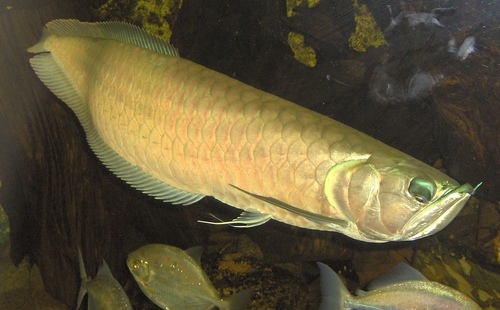
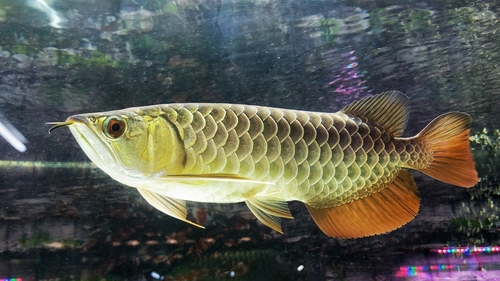
Asian arowanas (Scleropages formosus) grow up to 90 cm (35 in) in total length. Like all members of the genus Scleropages, they have long bodies, large elongated pectoral fins, and dorsal and anal fins positioned far back on the body. Their caudal fin is much larger than that of the silver arowana (Osteoglossum bicirrhosum), their South American relative. Their mouth is angled obliquely with a very wide gape, and the prominent lower jaw has two barbels at its tip. The gill rakers are stout. Asian arowanas have teeth on many bones of the mouth, including the jaws, vomer, palatines, pterygoids, parasphenoid, and tongue. Their scales are large and cycloid, and are metallic-coloured in some varieties, with a distinctive mosaic pattern of raised ribs. Lateral scales are arranged in horizontal rows numbered from the most ventral first level to the most dorsal fifth level, with dorsal scales designated as the sixth level. Asian arowanas can be distinguished from their Australian congeners Scleropages jardinii and Scleropages leichardti by having fewer lateral line scales (21–26, compared to 32–36 for the Australian species), longer pectoral and pelvic fins, and a longer anterior snout. Green arowanas have dark green colouration on the back, silvery or golden green colouration on the sides, and silvery or whitish colouration on the ventral surface, with dark greenish or bluish patches visible through the lateral scales. In mature green arowanas, the top of the eye and the head behind the eye are bright emerald. Both grey-tailed and yellow-tailed silver Asian arowanas are dark grey on the back and silver on the sides, with dark ring patches on the lateral scales and a silvery or whitish belly. In yellow-tailed specimens, the fin membranes are yellowish with dark-grey rays. In grey-tailed specimens, the fins are uniformly dark grey. Mature red-tailed golden arowanas have brilliant metallic gold lateral scales, gill covers, bellies, and pectoral and pelvic fin membranes, though their back is dark. In juveniles, the areas that will develop golden colour start out metallic silver. The anal fin and the bottom portion of the caudal fin are light brown to dark red. Mature gold crossback arowanas are distinguished from red-tailed golden arowanas by having metallic gold that crosses the back completely. This variety also lacks the reddish fins that red-tailed golden arowanas have. In mature super red arowanas, the gill covers, lateral scales, and fin membranes are metallic red, with the exact hue ranging from gold-tinged to deep red. The back is dark brown. In super red arowana juveniles, darker dorsal colouration correlates to a deeper red colour when the fish reaches maturity. Unlike most fish, the Asian arowana reaches sexual maturity relatively late, after 3 to 4 years. Females produce few, quite large eggs, between 30 and 100 total. After the eggs are fertilized, Asian arowanas provide extensive parental care via paternal mouthbrooding; both fertilized eggs and larvae are brooded inside the male's mouth.