About Scleroderma polyrhizum (J.F.Gmel.) Pers.
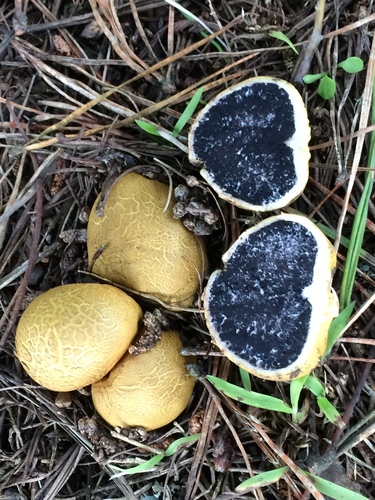
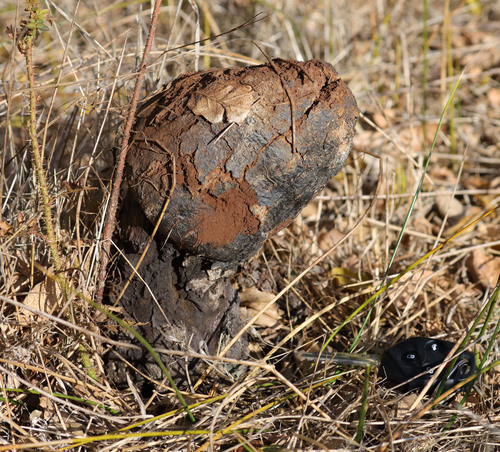
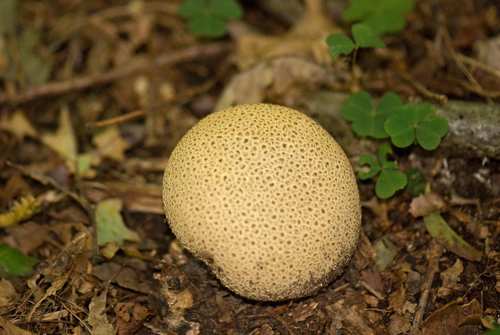
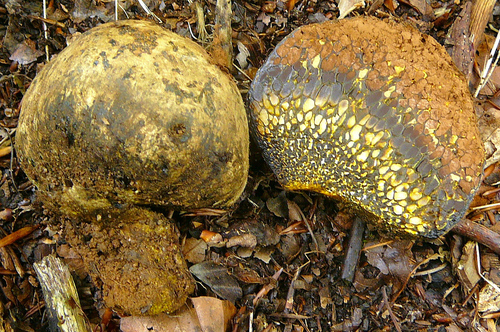
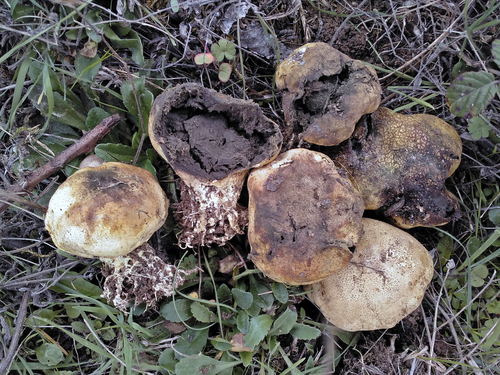
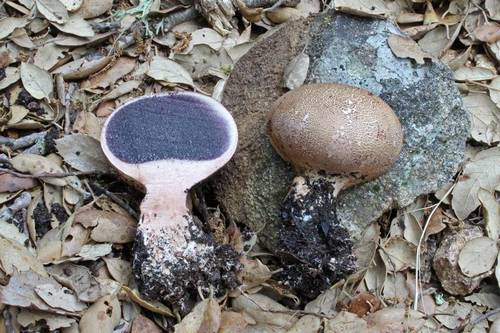
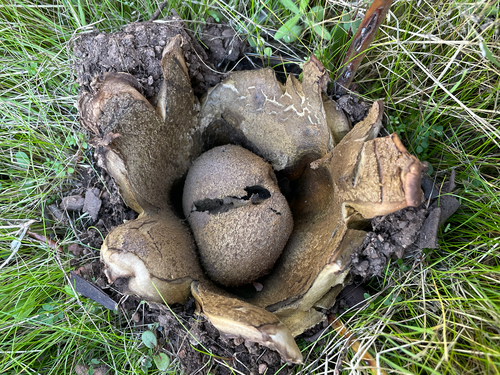
Scleroderma polyrhizum (J.F.Gmel.) Pers. has a fruit body that ranges from round, flattened, to somewhat irregular in shape when unopened, and sometimes grows lobes. As the fungus matures, the outer peridium opens in a star-shaped pattern, forming 4 to 8 rays that curl back to expose the inner spore mass called the gleba. Typically, more than half of the fruit body stays buried underground, attached by white, string-like or flattened strands called rhizomorphs. The peridium is tough and thick, usually 0.3–1 cm (0.1–0.4 in), with a rough and cracked surface. It starts out white, then changes to yellowish to light brown as it matures. Unopened fruit bodies measure 4–15 cm (1.6–5.9 in) wide, and expand to 12–30 cm (4.7–11.8 in) after rupturing. In young specimens, the gleba is firm and light grey, but becomes dark brown and powdery once spores mature. The spores are spherical, partially reticulate with warts or spines, and measure 6–11 μm. When a drop of dilute potassium hydroxide is placed on the fruit body surface, the peridium either shows no reaction or turns slightly yellow. Fruit bodies of Scleroderma polyrhizum grow singly, scattered, or in clusters, most often on hard clay, sandy soil, gravel, lawns, or bare soil. Fruiting happens in late summer and fall, though blackened rays can sometimes still be found in winter. It has a wide distribution across North America including Mexico, and has also been recorded in Africa, Asia (China and Japan), Europe, South America (Brazil), and Oceania. While Scleroderma polyrhizum is probably a saprobic species, experimental evidence indicates it can also form mycorrhizae. When a spore slurry was inoculated onto Monterey pine (Pinus radiata) seedlings, the fungus grew ectomycorrhizae that were dichotomously branched, forming coral-like structures made up of more than 50 branches. These structures were 1–2 mm long and 0.4–0.6 mm in diameter. This species contains toxins that cause serious gastric upset if ingested, and it also closely resembles other poisonous species. Fruit bodies of Scleroderma polyrhizum have been used in traditional Chinese medicine for detumescence and hemostasis, and they contain a variety of ergosterol-type steroids.