About Scleroderma meridionale Demoulin & Malençon
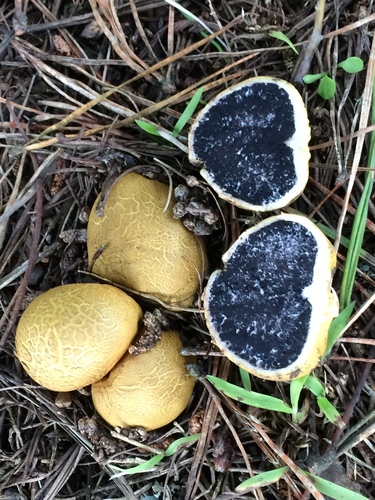
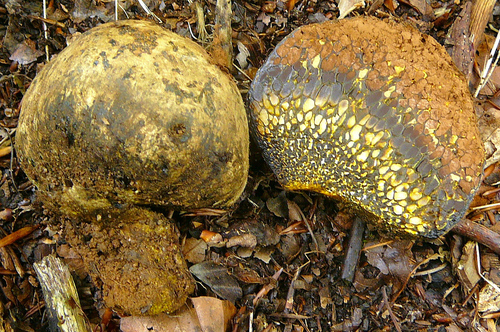
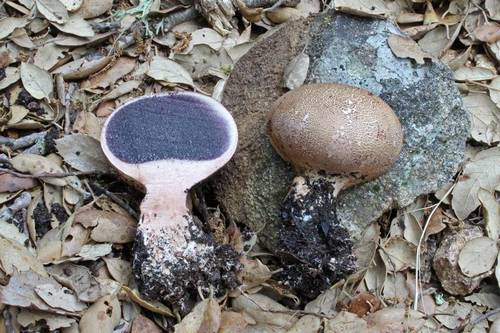
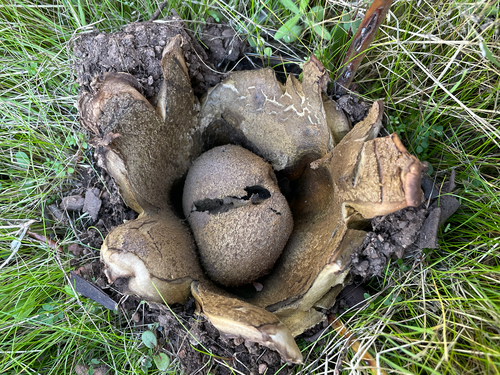
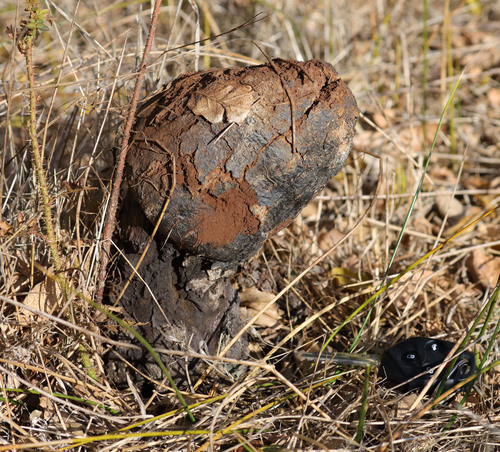
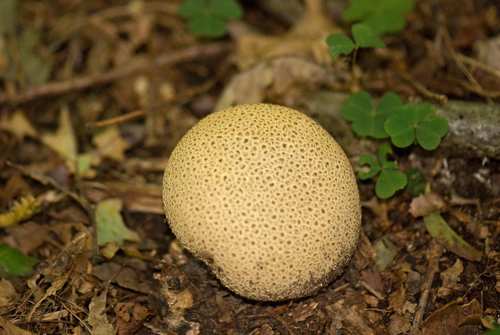
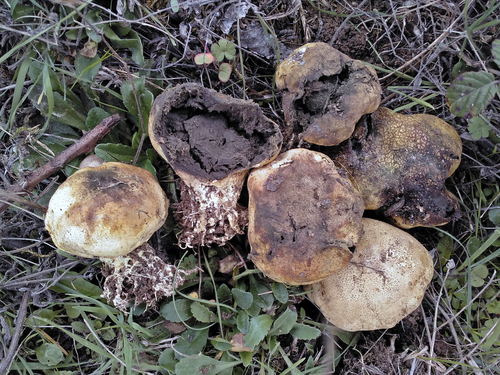
This fungus produces fruit bodies that range from roughly circular to irregular in shape, reaching up to 6 cm (2.4 in) in diameter, with a thick, rooting base. The peridium (outer fruit body layer) is up to 2 mm thick, with a dry, roughened surface colored tan to yellow. Dry peridia are often an intense sulfur yellow, with a felty to finely furfuraceous (scaly) texture, and may develop silver-grey patches as the outer layer weathers. Mature fruit bodies tend to split into irregular lobes, exposing a dark brownish- to blackish-grey spore mass called the gleba. The spores are spherical, covered in small spikes, and measure 12–20 μm. Scleroderma meridionale grows in sandy areas, producing fruit bodies singly or scattered, in a partially buried state. The edibility of this species is unknown. Scleroderma meridionale typically lives in sandy, dry soils in coastal and inland environments of the Mediterranean basin, including coastal dunes, open maquis, and pine woodlands. Its fruit bodies are roughly spherical, with a stalk-like extension called a pseudostipe that is often buried deep in the substrate, an adaptation to xeric, nutrient-poor conditions. Though originally described from southern Portugal, continental France, Corsica, and Morocco, it is now recorded across the entire Mediterranean basin, including Greece, North Macedonia, and Turkey. Isolated reports of the species from North America (ranging from Florida to Arizona) are still pending molecular confirmation. This species forms ectomycorrhizal associations with a wide variety of woody host plants, including coniferous genera such as Pinus, deciduous oaks (Quercus), and shrubs in the family Cistaceae (specifically Cistus salviifolius and Halimium halimifolium). Ectomycorrhizae formed on Cistaceae are typically small and coralloid, matching the fine-root morphology of these host plants. This generalist symbiotic strategy, with little host specificity, may have helped the species achieve its wide geographic distribution and ecological success across varied Mediterranean habitats. As an ectomycorrhizal fungus, S. meridionale helps host plants take up water and nutrients in drought-prone, disturbance-affected ecosystems. Its ability to colonize nutrient-poor and fire-impacted soils highlights its ecological plasticity and suggests it may have potential utility for restoration and reforestation of degraded Mediterranean landscapes.