About Sclerodactyla briareus (Lesueur, 1824)
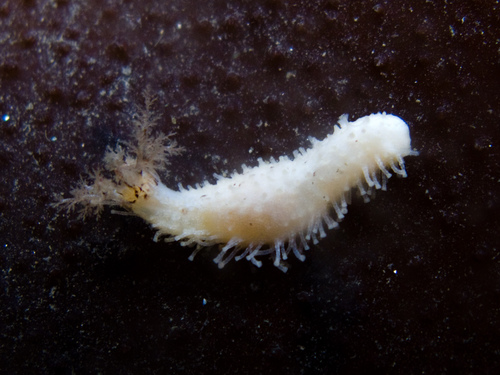
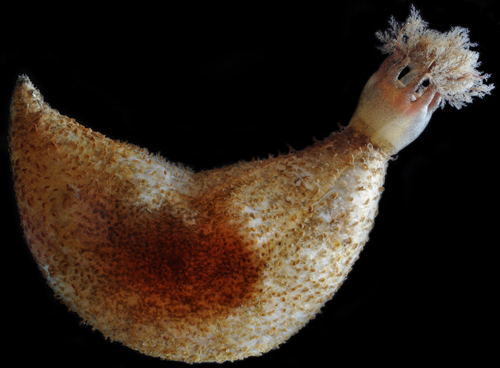
Sclerodactyla briareus is an elongated oval or cigar-shaped sea cucumber that grows to about 15 centimetres (5.9 in). It often holds a characteristic pose with both ends raised above the seabed substrate. Its anterior end has a mouth surrounded by a ring of ten short, branched feeding tentacles. These tentacles are modified tube feet, and can be retracted back into the mouth when the animal is not feeding. The body surface is divided into five ambulacral areas, with five shallow interambulacral grooves between these areas. Internally, five bands of muscle run along the ambulacrae, and transverse muscle bands are also present. Just behind the tentacles, a group of small calcareous stiffening plates called ossicles forms a short tube surrounding the pharynx. These ossicles provide skeletal support for the muscles and internal organs. The skin is thick and leathery, and the tube feet are scattered across the body instead of arranged in orderly rows, protruding out of the body wall as soft finger-like projections. Minute calcareous spicules embedded in the skin are characteristic of this species: they are square or round, table-shaped, with spires formed of four pillars. This sea cucumber is dark greenish-brown or charcoal grey, with pale grey tentacles growing on blackish stems. Sclerodactyla briareus is found in shallow water along the east coast of the United States from Massachusetts to Florida. It is also present in the Gulf of Mexico and the Caribbean Sea, and its range extends southward as far as Venezuela.