About Sclerocactus glaucus (K.Schum.) L.D.Benson
Sclerocactus glaucus, the Colorado hookless cactus, is a rare cactus species endemic to the U.S. state of Colorado, where it only occurs in the region between Grand Junction and Montrose. It is a federally listed threatened species.
Previously, this species description included two cactus taxa now recognized as separate species: Sclerocactus brevispinus and Sclerocactus wetlandicus, both of which are endemic to Utah. When the second of these two species was split off in 1994, the scientific name S. glaucus was restricted exclusively to the Colorado populations. This reclassification made the former common name Uinta Basin hookless cactus a misnomer, as S. glaucus no longer includes any populations native to Utah's Uinta Basin. The two newly separated species retained their federally threatened status, which they had already been granted when they were still classified as part of S. glaucus. Not all sources recognize the split of these species from S. glaucus; for example, Anderson (2001) does not.
This cactus has a cylindrical shape, reaching a maximum size of 28 centimeters tall by 9 centimeters wide, though most individuals are much shorter. During the dry season, it can shrink so substantially that it disappears entirely beneath the soil surface. Each areole produces up to 12 white radial spines, plus several straight central spines that can be whitish, reddish, or black, and point in multiple directions. Central spines can reach 1 to 2 centimeters long, or even longer.
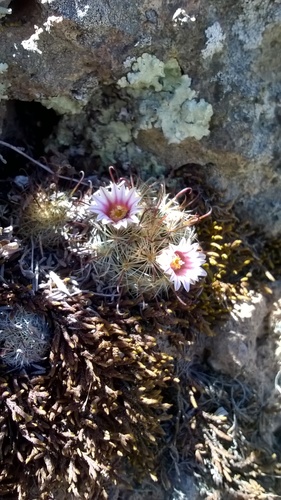
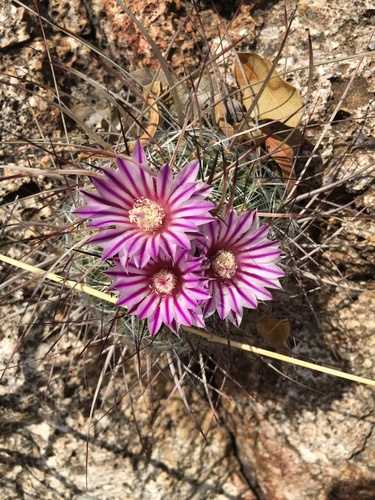
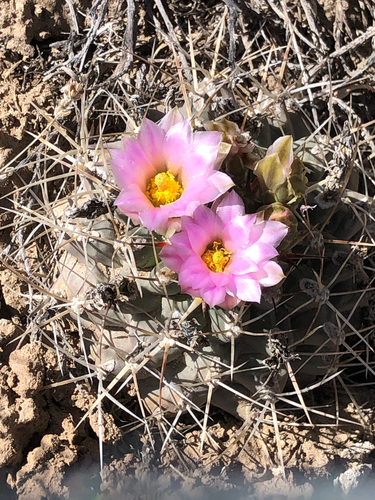
Its flowers are fragrant, funnel- or bell-shaped, up to 5 or 6 centimeters long, and have pink tepals. The stamens have white or green filaments and yellow anthers. The fruit is barrel-shaped, growing up to 2 or 3 centimeters in length.
S. glaucus grows on exposed areas of gravelly clay, including on alluvial benches above floodplains and on mesa slopes, near the Green, Colorado, and Gunnison Rivers. It occurs in saltbush- and sagebrush-dominated desert shrub plant communities, or in pinyon-juniper woodlands. Associated plant species in its habitat include shadscale (Atriplex confertifolia), galleta (Hilaria jamesii), black sagebrush (Artemisia nova), Indian rice grass (Stipa hymenoides), strawberry hedgehog cactus (Echinocereus triglochidiatus var. melanacanthus), Simpson's pincushion cactus (Pediocactus simpsonii), prickly pear cactus (Opuntia polyacantha), winterfat (Krascheninnikovia lanata), yucca (Yucca harrimaniae), snakeweed (Gutierrezia sarothrae), low rabbitbrush (Chrysothamnus viscidiflorus), sand dropseed (Sporobolus cryptandrus), and Salina wildrye (Leymus salinus).
The species faces many threats. Almost all of its populations are at risk from habitat loss and degradation caused by human activities including hydrocarbon exploration, residential development, rock mining, and the introduction of livestock to the region. It has already been impacted by the TransColorado Pipeline, and the petroleum industry is projected to bring large population growth to this rural area. Poaching is also an active threat to the species.