About Sclateria naevia (Gmelin, 1788)
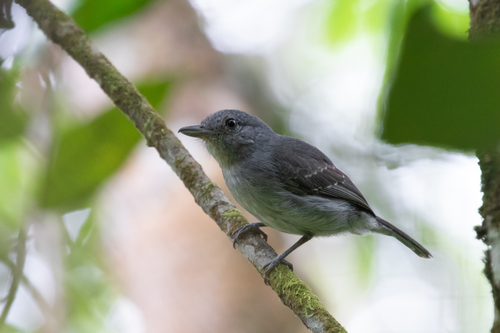
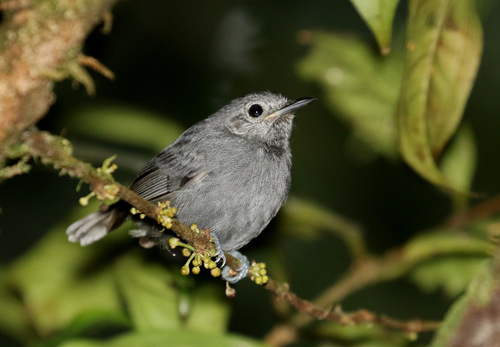
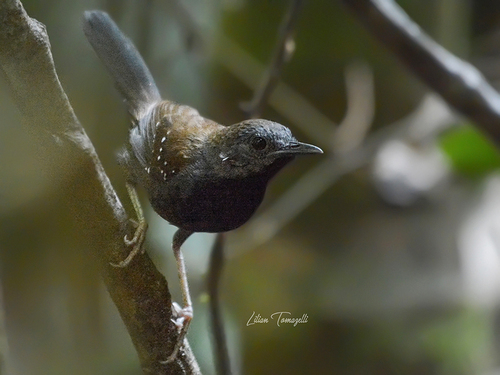
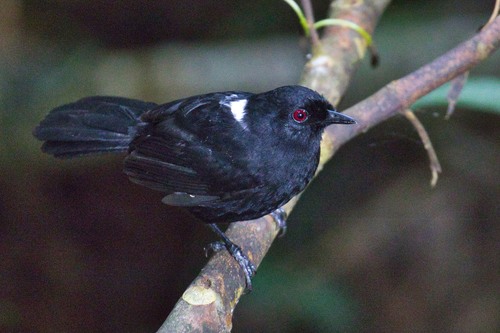
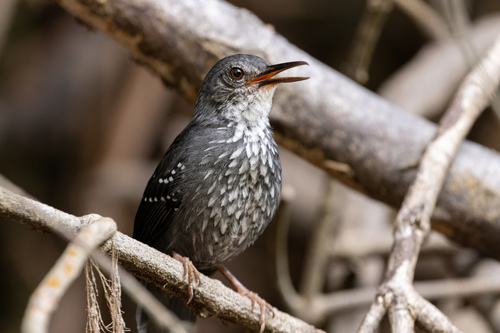
Silvered antbird (Sclateria naevia (Gmelin, 1788)) is 14 to 16 cm (5.5 to 6.3 in) long and weighs 21 to 27 g (0.74 to 0.95 oz). Adult males of the nominate subspecies S. n. naevia have a dark gray crown, nape, and upperparts. Their wings and tail are blackish gray with white tips on the wing coverts. Their face is mostly dark gray with a paler gray supercilium. Their underparts are mostly white with gray scalloping that is lightest on the throat. Their flanks, crissum, and underwing coverts are gray. Adult females follow the same pattern as males, but are grayish brown instead of gray, and have cinnamon tips on the wing coverts. Subadult males resemble adult females. Males of subspecies S. n. argentata have almost white underparts with faint light gray mottling on the breast and flanks, and a paler gray crissum than the nominate subspecies. Females of S. n. argentata have grayer upperparts than the nominate; their underparts range from white with buffy brown sides and vent area to deep buff with browner sides and vent. S. n. toddi is intermediate between the nominate subspecies and S. n. argentata. Males of S. n. diaphora have small white dots rather than white tips on their wing coverts, and mostly gray underparts with a few thin white streaks on the breast. Females of S. n. diaphora have ochraceous tawny underparts with little to no mottling.
Four subspecies of silvered antbird have distinct distribution ranges. S. n. naevia is found in Trinidad, eastern Venezuela, the Guianas, and northeastern Brazil, mostly south of the Amazon. S. n. diaphora is found in the drainage of the lower Rio Caura in Venezuela's Bolívar state. S. n. argentata ranges from southeastern Colombia and southern Venezuela south through eastern Ecuador, eastern Peru, and western Amazonian Brazil into northwestern and eastern Bolivia. S. n. toddi occurs in south-central Amazonian Brazil south of the Amazon, from the Rio Madeira and Teles Pires to the Rio Tocantins.
The silvered antbird inhabits the floor and understorey of tropical evergreen forest, primarily várzea and igapó, occurring along streams, in terra firme, and in swampy areas within the forest. It favors areas with vine tangles, branches, and vegetation that overhang the water's edge. In Trinidad and Suriname, it also occurs in mangrove swamps. In Ecuador and Peru, it is found in Mauritia flexuosa palm swamps. In terms of elevation, it reaches 500 m (1,600 ft) in Venezuela and Colombia, 450 m (1,500 ft) in Ecuador, and 600 m (2,000 ft) in Peru.