About Sciurus variegatoides Ogilby, 1839
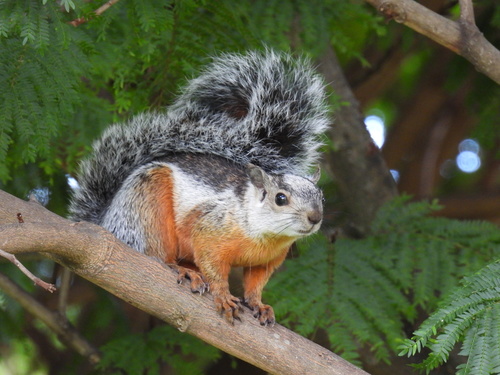
The variegated squirrel (Sciurus variegatoides Ogilby, 1839) is a medium-sized squirrel. It has an approximate head-and-body length of 260 mm (10.2 in), with a tail of roughly the same length, and weighs around 500 g (18 oz). Multiple subspecies of this squirrel differ in appearance, and there is often substantial variation in appearance between individual squirrels from the same population. Dorsal colouration ranges from dark brown to yellowish grey. The neck is typically darker than the rest of the body, and a paler patch is often present behind the ears. The underparts are usually some shade of cinnamon. The tail is long and densely bushy; in Mexico, the tail is black, and sometimes has white-tipped hairs that give it a frosted appearance. In Nicaragua and Costa Rica, some individuals have pale underparts and pale tails. This squirrel is native to Central America, with a range that extends south from Mexico through Guatemala, Honduras, El Salvador, Nicaragua, Costa Rica, and Panama. It can be found in dry deciduous forest, evergreen forest, secondary growth, and plantations, and can become a crop pest. It is mainly a lowland species, occurring up to an altitude of 1,800 m (5,910 ft), and reaches somewhat higher altitudes in Costa Rica. The variegated squirrel is diurnal and rarely descends to the ground. It spends nights in a nest it builds; the nest is sometimes located in a tree hole, but is more often made of leaves and built in the fork of a branch near the tree trunk. This squirrel is primarily a seed-eater, but also eats fruits and small amounts of animal matter in the form of insects and nestlings. It tends to avoid hard-shelled seeds, but does eat acorns. Unlike some other squirrel species from colder climates, it does not hoard food, so it plays very little part in seed dispersal.