About Sciurus stramineus Eydoux & Souleyet, 1841
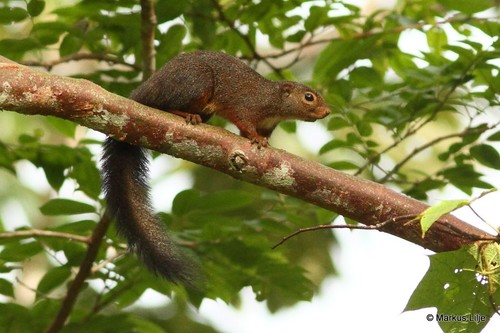
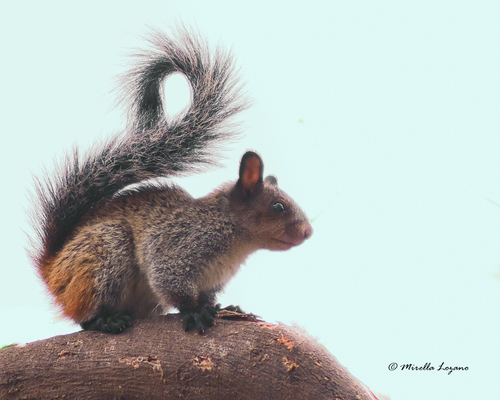
Guayaquil squirrels (scientific name Sciurus stramineus Eydoux & Souleyet, 1841) are relatively heavily built squirrels, with an average weight of around 470 grams (17 oz). Their head-body length ranges from 18 to 32 centimetres (7.1 to 12.6 in), and they have a long tail that measures 25 to 33 centimetres (9.8 to 13.0 in), which is long in proportion to their body. While the scientific name translates to "straw-coloured squirrel", the coat colour of this species is actually highly variable. Past efforts to classify different subspecies based on coat colour are no longer accepted, as there was no clear distinction between the proposed groups. At least two main colour morphs exist for the species. The paler morph, which is more common in Peru, has pale grey fur grizzled with white across most of the body, a buff rump, a white or pale yellow patch on the back of the neck, and grey underparts. The darker morph, which is more common in Ecuadorian lowlands, has grey fur on the forequarters, dull orange hindquarters, grizzled black and white shoulders, and grey underparts. Even these two morphs show high individual variation: some individuals lack the shoulder or rump patches, and others have tawny or even reddish underparts instead of grey. A third, rarer melanistic morph has also been recorded; this morph has nearly all-black fur across the body, with only a white patch on the collar and occasional white spots on the back. All morphs of Guayaquil squirrel have black ears and a slender grey tail. The slender grey tail can be used to distinguish this species from the only other tree squirrel native to Ecuador, the red-tailed squirrel. Guayaquil squirrels are found in the wild only in southwestern Ecuador and northwestern Peru. A small population has also been introduced to parks in Lima. They live in a range of forest types, from dry to humid, along the western slopes of the Andes, at elevations between 300 and 2,000 metres (980 and 6,560 ft). They have also been recorded living in coffee plantations. No subspecies of Sciurus stramineus are currently recognised.