About Sciurus oculatus Peters, 1863
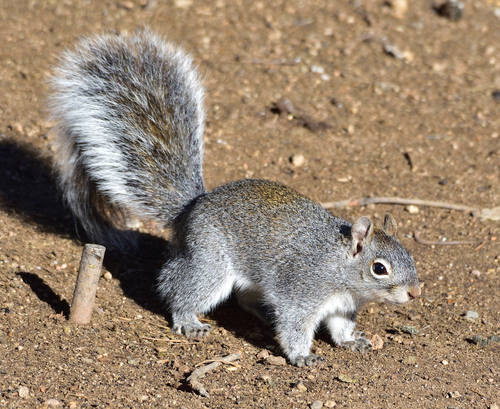
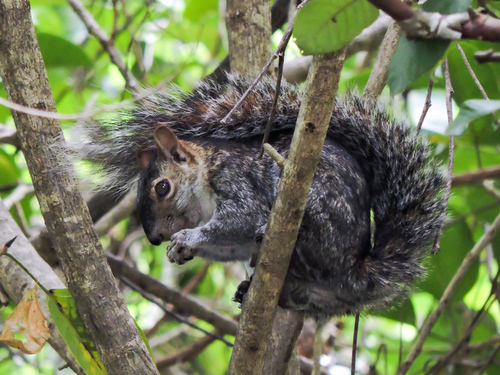
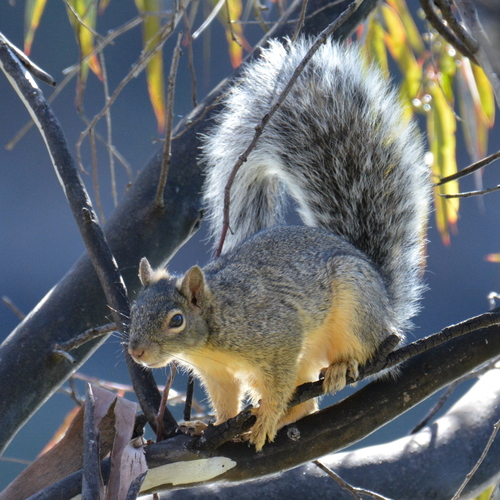
Peters's squirrel (Sciurus oculatus Peters, 1863) is a large, primarily arboreal squirrel species. Its head-and-body length ranges from 510 to 560 mm (20 to 22 in), its tail measures approximately 260 mm (10 in), and its body weight falls between around 550 to 750 g (19 to 26 oz). While colouring varies slightly between subspecies, the species is generally grey on its dorsal side, where individual hairs have dark brown or black bases, and white or cream on its ventral side. The upper portion of the tail is blackish, while the underside is dark with hairs that have white tips. It has a pale ring of skin around the eyes, and a key identifying characteristic is its dentition: it has one fewer upper premolar than other related squirrel species. This squirrel is endemic to Mexico, where it occurs in the states of Guanajuato, Hidalgo, México State, Puebla, Querétaro, San Luis Potosí and Veracruz. It lives in pine and oak forests at altitudes between roughly 1,500 and 3,600 m (4,900 and 11,800 ft), and can also be found on arid mountainsides and in valleys containing arroyos. Sciurus oculatus is a diurnal species that typically lives solitarily. Individuals are often seen during the summer, but are not sighted during the winter. Its diet is mostly made up of acorns and pine seeds, but it also consumes other fruits and seeds, including wild figs and plums. The mating season appears to occur in summer, and during this period up to twenty individuals can gather on a single tree; little else is known about this species' breeding behaviour. In parts of its range, it co-occurs with the Mexican gray squirrel (Sciurus aureogaster) and the southern flying squirrel (Glaucomys volans).