About Sciurus niger Linnaeus, 1758
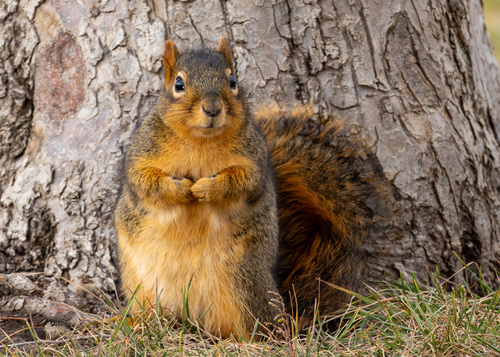
Sciurus niger Linnaeus, 1758, commonly known as the fox squirrel, has a total length of 20 to 30 inches (50.8 to 76.2 cm), with a body length of 10 to 15 inches (25.4 to 38.1 cm) and a tail of similar length to the body. Their body weight ranges from 1.0 to 2.5 pounds (453.6 to 1,134.0 g), and their hind foot measures 5.1 to 8.2 cm. There is no sexual dimorphism in size or appearance, and individuals from western parts of the species' range tend to be smaller. There are three distinct geographical color morphs. In most areas, the upper body is brown-grey to brown-yellow with a typically brownish-orange underside. In eastern regions such as the Appalachians, there are more prominently patterned dark brown and black individuals with white bands on the face and tail. In the southern United States and parts of Nebraska and Iowa along the Missouri River, there are populations with uniform black coats. To support climbing, fox squirrels have sharp claws, well-developed digit extensors and forearm flexors, and specialized abdominal musculature. They have excellent vision, and well-developed senses of hearing and smell, and they use scent-marking to communicate with other fox squirrels. They have several sets of vibrissae (thick hairs or whiskers that act as touch receptors to sense the environment), which are located above and below the eyes, on the chin and nose, and on each forearm. The dental formula for S. niger is 1.0.1.3 / 1.0.1.3 × 2 = 20 total teeth.
The natural range of the fox squirrel covers most of the eastern United States, extending north into the southern prairie provinces of Canada, west to the Dakotas, Colorado, and Texas, and south to the northern parts of Coahuila, Nuevo León (reaching as far south as the Valle de las Salinas) and Tamaulipas. Except for vagrant individuals, it is not present in New England, New Jersey, most of New York, northern and eastern Pennsylvania, Ontario, Quebec, and the Atlantic provinces of Canada. The species has been introduced to northern and southern California, Oregon, Idaho, Montana, Washington, New Mexico, and the Canadian provinces of Ontario and British Columbia.
Fox squirrels are very versatile in habitat selection, but are most commonly found in forest patches of 40 hectares or less with an open understory, or in urban neighborhoods with trees. They thrive in stands of oak, hickory, walnut, pecan, and pine, and store nuts from these trees for winter use. Western range expansions into Great Plains regions like Kansas are associated with riverine cottonwood corridors. Recognized subspecies native to multiple eastern U.S. states include the Delmarva Peninsula fox squirrel (S. n. cinereus) and the southern fox squirrel (S. n. niger). Fox squirrels are most abundant in open forest stands with sparse understory vegetation; they do not occur in stands with dense undergrowth. The ideal habitat is small stands of large trees interspersed with agricultural land. The size and spacing of pines and oaks are important features of fox squirrel habitat, while the specific pine and oak species themselves are not always a major factor in defining suitable habitat. Fox squirrels are often seen foraging on the ground several hundred meters from the nearest woodlot, and they commonly occupy forest edge habitat.
Fox squirrels use two types of shelters: leaf nests called dreys and tree dens. Individuals may have two tree cavity homes, or one tree cavity and one leaf nest. Tree dens are preferred over leaf nests during winter and for raising young. When den trees are scarce, leaf nests are used year-round. Leaf nests are built in summer in the forks of deciduous trees, around 30 feet (9 m) above the ground. Fox squirrels use natural cavities and tree branch forks (crotches) as tree dens. In Ohio, den trees had an average diameter at breast height (d.b.h.) of 21 inches (53 cm), and were located an average of 58.6 yards (53.6 m) from the nearest woodland border. Around 88% of den trees in eastern Texas had an average d.b.h. of 12 inches (30 cm) or more. Dens are usually 6 inches (15 cm) wide and 14–16 inches (36–41 cm) deep. Den openings are generally circular and measure around 2.9 to 3.7 inches (7.4 to 9.4 cm). While fox squirrels may create their own den in a hollow tree by cutting through the interior, they most often use natural cavities or cavities created by northern flickers (Colaptes auratus) or red-headed woodpeckers (Melanerpes erythrocephalus). They have also been recorded using abandoned crow nests. Fox squirrels use both leaf nests and tree cavities for shelter and raising young. Forest stands dominated by mature to over-mature trees provide enough cavities and leaf nest sites to meet their shelter needs. Overstory trees with an average d.b.h. of 15 inches (38 cm) or more generally provide adequate cover and reproductive habitat. The optimum tree canopy closure for fox squirrels is 20% to 60%, and optimum understory conditions occur when shrub-crown closure is 30% or less. Fox squirrels tolerate close proximity to humans, and even thrive in crowded urban and suburban environments, using human habitations for food and nesting sites—they nest just as readily in an attic as in a hollow tree.
Fox squirrels are strictly diurnal and non-territorial, and spend more time on the ground than most other tree squirrels, though they remain agile climbers. They build two types of dreys depending on the season: summer dreys are often little more than stick platforms high in tree branches, while winter dens are typically hollows in tree trunks that have been reused by successive occupants over up to 30 years. Cohabitation of these dens is not uncommon, particularly between breeding pairs. Fox squirrels create food caches by burying items for later consumption. They prefer to store shelled, high-fat foods such as acorns and nuts: shelled foods are favored because they are less likely to spoil than non-shelled foods, and fatty foods are valued for their high energy density. Fox squirrels are not particularly gregarious or playful; they have been described as solitary and asocial, only coming together during the breeding season. They have a large vocabulary, most notably a range of clucking and chucking sounds similar to those of some game birds, and they use distress screams to warn of approaching threats. In spring and autumn, groups of fox squirrels clucking and chucking together can create noticeable noise. They also produce high-pitched whines during mating. When threatening another fox squirrel, they stand upright with their tail held over their back and flick the tail. Fox squirrels are skilled jumpers: they can easily complete horizontal leaps of 15 feet, and can free-fall 20 feet or more to land softly on a tree limb or trunk.
Female fox squirrels enter estrus in mid-December or early January, and again in June. They normally produce two litters per year, though yearling females may only produce one. Females reach sexual maturity at 10 to 11 months of age, and usually produce their first litter when they are 1 year old. While females can bear young as early as 8 months of age, most first reproduce after 16 months of age. The reproductive longevity of fox squirrels can exceed 12 years. Gestation lasts 44 to 45 days. The earliest litters are born in late January, with most births occurring in mid-March and July. The average litter size is three, but can change based on season and food availability. Tree cavities (usually those created by woodpeckers) are remodeled into winter dens and often act as nurseries for late winter litters. If available trees do not have cavities, fox squirrels build leaf nests (dreys) by cutting leafy twigs and weaving them into warm, waterproof shelters. Similar leafy platforms called "cooling beds" are built for summer litters. Like other tree squirrels, fox squirrels develop slowly compared to many other mammals. Newborn young are blind, hairless, and helpless. Their eyes open at 4 to 5 weeks, and their ears open at 6 weeks. They are weaned between 12 and 14 weeks, but may not become fully self-supporting until 16 weeks. Juveniles usually disperse in September or October, but may den together or with their mother during their first winter.