About Sciurus griseus Ord, 1818
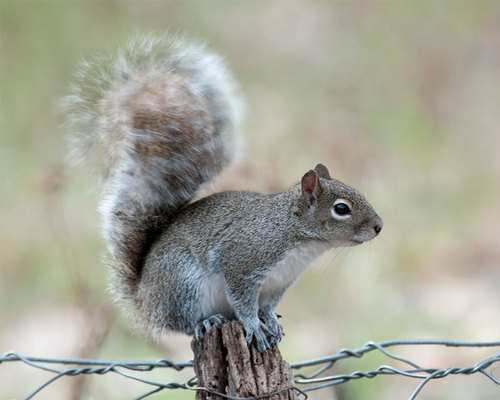
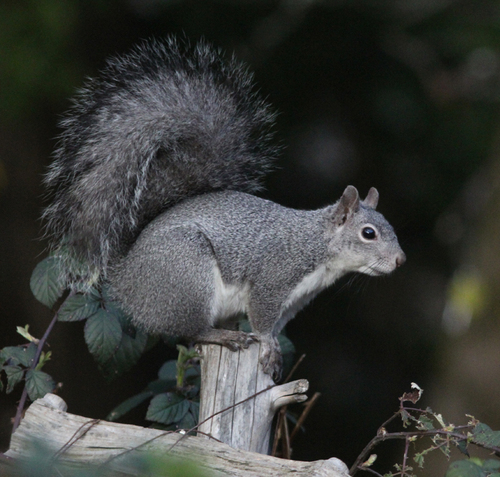
The scientific name of the western gray squirrel is Sciurus griseus Ord, 1818. George Ord first described this species in 1818, using notes collected by Lewis and Clark at The Dalles in Wasco County, Oregon. Sciurus griseus is the largest tree squirrel found in the Sierra Nevada and Central California range, and also the largest native tree squirrel of the Pacific Northwest. It has plantigrade, pentadactyl feet with two phalanges; it has four toes on each front foot and five toes on each back foot. Compared to the introduced eastern gray squirrel (S. carolinensis) and fox squirrel (S. niger), western gray squirrels are shy. When disturbed, they typically run up a tree and emit a hoarse chirping call. Adult weights range from around 0.35 to 1 kilogram (0.77 to 2.20 lb), and total body length including the tail ranges from 43 to 61 centimetres (17 to 24 in). Western gray squirrels have a distinct color pattern across their bodies: most of the body, especially the back and sides, is covered in solid gray fur. Tree squirrels like this species undergo a full head-to-tail molt in spring, and a rump-to-head molt in fall. Only spring brings replacement of tail hair, and nesting mothers use this shed tail hair to line their birthing nests. The diet of western gray squirrels includes berries, nuts, a variety of seeds, and small birds' eggs. The dental formula for S. griseus is 1.0.2.3 / 1.0.1.3 × 2 = 22. Western gray squirrel nests, called dreys, are visible in trees and constructed from sticks and leaves wrapped with long strands of grass. The species builds two distinct types of stick nests. The first is a large, round, covered shelter nest used for winter, as well as for birthing and rearing young. The second is a seasonal or temporary base properly called a "sleeping platform". Both nest types are built from sticks and twigs, and lined with leaves, moss, lichens, and shredded bark; birthing nests may also be lined with tail hair. Nests measure 43 to 91 cm (17 to 36 in) by up to 46 cm (18 in), and are typically located in the top third of a tree. When weather allows, young or traveling squirrels will "sleep rough" by balancing spread-eagled on a tree limb high above the forest floor; this behavior is also used for cooling in hot weather, and has also been observed in raccoons. The western gray squirrel is an arboreal species that requires sufficient tree cover for traveling through trees. It lives in woody areas to build its complex nests, and occupies both high and low elevations in California, found at elevations up to 2,000 m. It occurs in habitats with walnut trees and black oak trees, across the Pacific Northwest. It has also been recorded in several human-made locations in California, including Bidwell Park and the campus of California State University, Chico. The western gray squirrel has many predators: red-tailed hawks (Buteo jamaicensis), great horned owls (Bubo virginianus), eagles (Accipitridae), bobcats (Lynx rufus), coyotes (Canis latrans), cougars (Puma concolor), domestic cats (Felis catus) and domestic dogs (Canis familiaris). Predation does not control the species' population density. In Washington State, the western gray squirrel was listed as a threatened species in 1993, and was reclassified as endangered in November 2023. Populations have not recovered from past declines. Threats to the species include habitat loss, road mortality, and disease. Habitat loss stems from urbanization, catastrophic wildfires, and forest areas degraded by fire suppression and overgrazing, which allow the invasion of Scotch broom. Notoedric mange, a disease caused by mites, becomes epidemic in western gray squirrel populations and is a major source of mortality. Other expanding species including eastern gray squirrels, fox squirrels, California ground squirrels, and wild turkeys compete with the western gray squirrel. The species is listed as extirpated in some areas of California. In southern California, it is generally found only in mountains and surrounding foothill communities. Local rehabilitation experts record that fox squirrels were released in urban regions of Los Angeles throughout the 20th century; fox squirrels were first introduced to the Los Angeles area around 1904. Civil War and Spanish–American War veterans living at the Sawtelle Veterans Home on Sepulveda and Wilshire Boulevards brought fox squirrels as pets to this site from their homes in areas around the Mississippi Valley, possibly Tennessee. Other more recent introductions of fox squirrels to the Los Angeles area have likely occurred, but no detailed records are available. These more aggressive non-native squirrels pushed the reclusive western gray squirrels back into the mountains where competition is weaker. This non-native species introduction is considered the largest threat to western gray squirrels in southern California. Western gray squirrels reach sexual maturity at 10 to 11 months old, and begin breeding at approximately one year of age. Mating occurs over an extended period from December through June. Young are born after an approximate 44-day gestation period. Juveniles leave their nests between March and mid-August. Litter sizes range from one to five kits. Kits remain in the nest for a longer period than young of other squirrel species, as their development is relatively slow; they do not leave the nest for six months or more. This slow development is another disadvantage for the species when competing with other squirrels whose young fledge more quickly. Young western gray squirrels have incompletely furred tails, which only reach full fullness when they reach adulthood, making tail fullness a reliable indicator of age and maturity. Mother squirrels often appear overworked and stressed, with bruised and damaged nipples. Mating encounters can be very physical, and mating squirrels will bite and injure each other. Females are quite territorial, and will chase other squirrels away, engaging in fairly violent altercations with one another.