About Sciurus deppei Peters, 1863
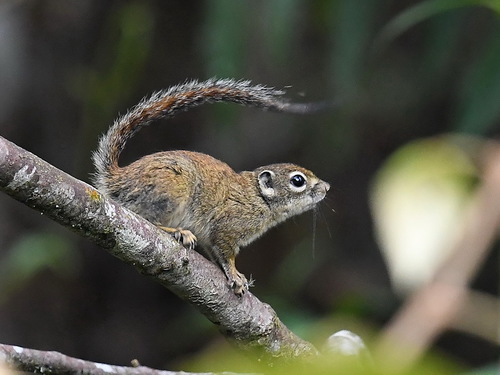
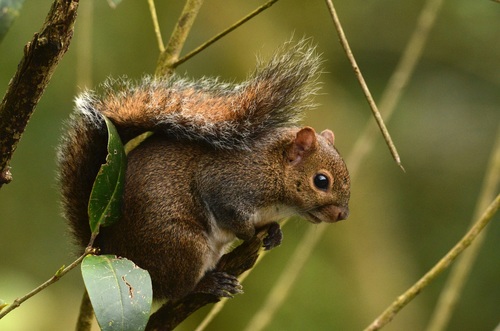
Sciurus deppei, commonly known as Deppe's squirrel, shows individual variation in coloration. Its overall body color ranges from gray to yellowish brown or rusty brown, and the face is always gray. Legs are dark gray or rust colored. The upper side of the tail is black mixed with a small number of white hairs, while the underside of the tail is yellowish orange to rust colored, and the hairs at the tail tip are white. Seasonal fur changes are not common in this species, with two exceptions: the white tail tip and patches of hair behind the ears disappear during the summer. Deppe's squirrel shows only slight size variation between individuals. On average, females weigh around 287.3 g, have a head-and-body length of 210.2 mm, and a tail length of 169.4 mm. On average, males weigh around 268.3 g, have a head-and-body length of 207.2 mm, and a tail length of 176.0 mm. Both sexes are similar in overall size, but females tend to be slightly larger than males. The range of S. deppei overlaps with that of many other squirrel species across Mexico, Guatemala, Costa Rica, and the Mexican state of Chiapas. This range includes Guatemala's Tikal National Park, where populations of Deppe's squirrel can be found around Mayan ruins. Research conducted in this area investigated whether human activity impacts animal populations in high-traffic tourist sites, and found that higher populations of S. deppei occur around the ruins than in undisturbed control areas. According to the IUCN, the overall population of S. deppei is stable. S. deppei is classified as a habitat generalist. It generally favors lowland areas with moist, dense tropical forest vegetation. Because it occurs across Mesoamerica, which has a wide diversity of climates, these squirrels can be found in many different types of habitats. Skull morphology of S. deppei aligns with its known habitat preferences. S. deppei can reproduce year-round, though most breeding activity occurs around the end of the dry season. Litter size varies widely from 2 to 8 young, with an average of around 4. Most species in the genus Sciurus have 4 pairs of mammae, but S. deppei only has 3 functional pairs. According to the 2015 generic key published by de Vivo & Carmignotto, this characteristic places this taxon in the genus Notosciurus, along with the red-tailed squirrel, Andean squirrel, and likely Richmond's squirrel.