About Sciurus carolinensis Gmelin, 1788
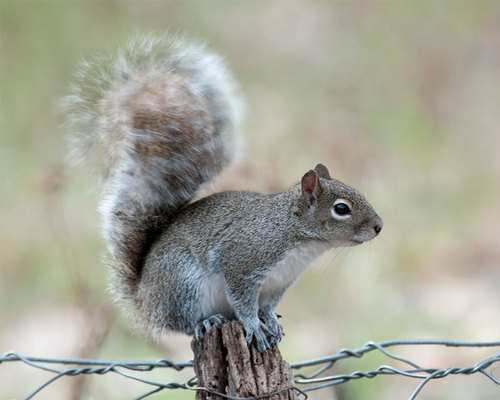
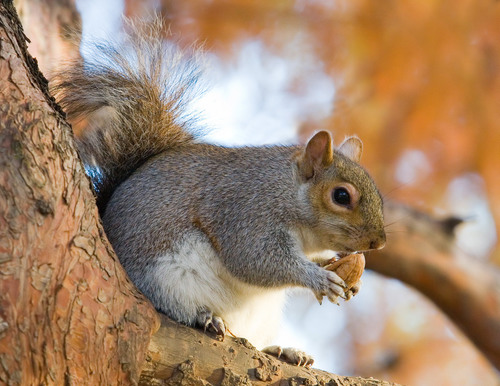
Characteristics: The eastern gray squirrel (Sciurus carolinensis Gmelin, 1788) has predominantly gray fur marked with brown spots and streaks, and a white underside. This differs from the fox squirrel, which has a brownish-orange underside; both species have countershading. It has a large, bushy tail. Particularly in urban areas where predation risk is low, both all-white and all-black individuals are commonly found. The almost entirely black melanistic form is the most common variant in certain populations and geographic areas, such as large parts of southeastern Canada. Melanistic eastern gray squirrels have higher cold tolerance than the common gray morph: when exposed to −10 °C, black squirrels have an 18% reduction in heat loss, a 20% reduction in basal metabolic rate, and an 11% increase in non-shivering thermogenesis capacity compared to the common gray morph. Black coloration comes from an incomplete dominant mutation of the MC1R gene, where E+/E+ corresponds to the wild type gray squirrel, E+/EB produces a brown-black color, and EB/EB produces a fully black color. The eastern gray squirrel’s combined head and body length ranges from 23 to 30 cm (9.1 to 11.8 in), its tail length ranges from 19 to 25 cm (7.5 to 9.8 in), and adult weight varies between 400 and 600 g (14 and 21 oz). The species does not have sexual dimorphism, so there are no differences in size or coloration between males and females. Eastern gray squirrel tracks are hard to distinguish from tracks of the related fox squirrel and Abert's squirrel, though Abert's squirrel’s range is almost entirely separate from that of the eastern gray. Like all squirrels, the eastern gray squirrel has four toes on its front feet and five on its hind feet. The hind foot-pad is often not visible in tracks. When bounding or moving at speed, front foot tracks are positioned behind hind foot tracks, and bounding strides measure 60 to 90 cm (2 to 3 ft) in length. The eastern gray squirrel has a dental formula of 1023/1013 (upper teeth/lower teeth), which calculates to 1.0.2.3 / 1.0.1.3 multiplied by two, for a total of 22 teeth. Its incisors grow continuously throughout life, an indeterminate growth pattern common to all rodents, while its cheek teeth are brachydont (low-crowned) and bunodont (with tubercles on the crowns).
Distribution: Sciurus carolinensis is native to the eastern and midwestern United States, and to the southern portions of the central provinces of Canada. By the mid-1800s, the midwestern United States population was described as "truly astonishing", but human hunting and habitat destruction from deforestation caused extreme population reductions, and the species was almost entirely absent from Illinois by 1900. The native range of the eastern gray squirrel overlaps with that of the fox squirrel (Sciurus niger), with which it is sometimes confused, though the core of the fox squirrel's range is slightly further west. The eastern gray squirrel’s range extends from New Brunswick, through southwestern Quebec, across southern Ontario, and into southern Manitoba, south all the way to East Texas and Florida. Breeding populations exist in Nova Scotia, but it is unknown whether this population came from natural range expansion or was introduced. A prolific and highly adaptable species, the eastern gray squirrel has been introduced to and thrives in several regions of the western United States. In 1966, it was introduced to Vancouver Island in Western Canada near Metchosin, where it is considered highly invasive and a threat to both the local ecosystem and the native American red squirrel. Outside of North America, eastern gray squirrels are a conservation concern in Europe because they have displaced some native squirrel populations. For example, they have largely displaced the native red squirrel in Britain, and compete with the Eurasian red squirrel in Ireland. They have also been introduced to Italy, South Africa, and Australia, where the introduced population was extirpated by 1973.
Habitat: In the wild, eastern gray squirrels live in large areas of mature, dense woodland ecosystems, generally covering at least 100 acres (40 hectares). These forests typically include large mast-producing trees such as oaks and hickories, which provide abundant food. Eastern gray squirrels generally prefer oak-hickory hardwood forests over coniferous forests because of the greater abundance of mast forage, which is why they only occur in parts of eastern Canada that do not have boreal forest: specifically, parts of New Brunswick, southwestern Quebec, all of southern Ontario, and southern Manitoba. Eastern gray squirrels usually build their dens on large tree branches and inside hollow tree trunks, and have also been documented using abandoned bird nests for shelter. Dens are usually lined with moss, thistledown, dried grass, and feathers, which help insulate the den to reduce heat loss. A covering for the den is usually added after construction. Squirrels use dens for protection from predators and to raise their young; young squirrels have a 40 percent lower survival rate if they live in a leaf nest rather than a tree den. Squirrels typically maintain and claim 2 to 3 dens at the same time. Squirrels use canopy and midstory trees to hide from predators like hawks and owls. A typical eastern gray squirrel’s home range spans 1.5 to 8 acres (0.61 to 3.24 ha), and home ranges tend to be smaller in areas with higher squirrel population density. Near human settlements, eastern gray squirrels are found in urban parks and residential backyards, as well as in rural farmland.
Behavior and ecology: Like many members of the squirrel family Sciuridae, the eastern gray squirrel is a scatter-hoarder; it stores food in many small caches to recover later. Some caches are only temporary, particularly those made near a sudden surplus of food, which are retrieved within hours or days to be reburied in a more secure location. Other caches are permanent and are not retrieved for months. Each squirrel is estimated to make several thousand caches every season. Squirrels have very accurate spatial memory for cache locations, and use both distant and nearby landmarks to retrieve their stores. They also use smell partially to uncover their own caches, and to find caches made by other squirrels, though scent is unreliable when the ground is very dry or covered in snow. Squirrels sometimes use deceptive behavior to stop other animals from stealing their cached food. For example, if they sense they are being watched, they will pretend to bury the food item. They do this by preparing the spot as they normally would (digging a hole or widening a crack), miming placing the food in the spot while actually keeping it hidden in their mouth, then covering the empty "cache" as if they had deposited the food there. They also hide behind vegetation while burying food, or hide food high up in trees if their rival does not climb. This complex set of behaviors suggests the actions are not innate, and implies the squirrels are capable of theory of mind thinking. The eastern gray squirrel is one of very few mammal species that can descend a tree head-first, which it accomplishes by rotating its hind feet so the hind claws point backward and can grip the tree bark. Eastern gray squirrels build a type of nest called a drey in the forks of trees, made mainly of dry leaves and twigs. Dreys are roughly spherical, 30 to 60 cm in diameter, and are usually insulated with moss, thistledown, dried grass, and feathers to reduce heat loss. Males and females may share the same drey for short periods during the breeding season, and during cold winter weather; squirrels may share a drey to stay warm. They may also nest in the attics or exterior walls of human homes, where they are often considered pests and pose a fire hazard from their habit of gnawing on electrical cables. Eastern gray squirrels may also occupy permanent tree dens hollowed out of a tree trunk or large branch. Eastern gray squirrels are active during the day (diurnal) or during twilight (crepuscular) depending on the season, and tend to avoid heat during the middle of summer days. They do not hibernate.
Reproduction: Eastern gray squirrels can breed twice a year, but younger, less experienced mothers typically only produce a single litter per year in spring. Depending on the availability of forage, older, more experienced females may breed a second time in summer. In years with abundant food, 36% of females produce two litters, while no females produce two litters in years with poor food availability. Breeding seasons occur from December to February and May to June, though breeding is slightly delayed at more northern latitudes. The first litter is born in February or March, and the second in June or July, though birth timing can be shifted a few weeks earlier or later depending on climate, temperature, and forage availability. In any given breeding season, an average of 61–66% of females produce young. If a female fails to conceive or loses her litter to unusually cold weather or predation, she will re-enter estrus and produce a later litter. Five days before a female enters estrus, she may attract as many as 34 males from as far as 500 meters away. Eastern gray squirrels have a polyandrous mating system, where competing males form a dominance hierarchy, and the female mates with multiple males based on this established hierarchy. Each litter normally has one to four young, though the maximum recorded litter size is eight. The gestation period is approximately 44 days. Young are weaned around 10 weeks of age, though some wild squirrels may wean up to six weeks later. Young begin to leave the nest after 12 weeks; autumn-born young often spend the winter with their mother. Only one in four squirrel kits survive to one year of age, with around 55% mortality in the following year. After that, mortality rates drop to around 30% per year until increasing sharply when individuals reach eight years of age. Rarely, female eastern gray squirrels can enter estrus as early as five and a half months old, but females are not normally fertile until they are at least one year old; their mean age of first estrus is 1.25 years. The presence of a fertile male induces ovulation in a female in estrus. Male eastern gray squirrels reach sexual maturity between one and two years of age. Reproductive longevity for females appears to extend past 8 years, with a 12.5 year reproductive lifespan documented in North Carolina. Eastern gray squirrels can live up to 20 years of age in captivity, but live much shorter lives in the wild due to predation and habitat challenges. At birth, the life expectancy of an eastern gray squirrel is 1–2 years; an adult typically lives to six years of age, with exceptional individuals reaching 12 years.
As food: Eastern gray squirrels were eaten historically by Native Americans, and their meat remains popular with hunters across most of their native range in North America. Today, squirrel meat is still available for human consumption and is occasionally sold in the United Kingdom. However, physicians in the United States have warned that squirrel brains should not be eaten, due to the risk that they may carry Creutzfeldt–Jakob disease.