About Sciurus arizonensis Coues, 1867
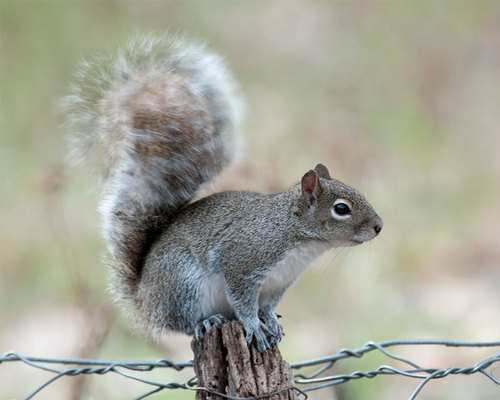
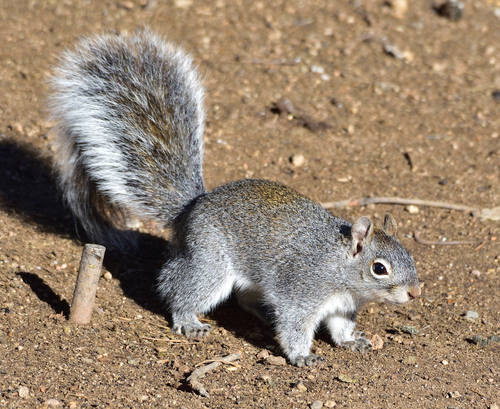
Sciurus arizonensis (common name Arizona gray squirrel), first described by Coues in 1867, is a member of the order Rodentia and family Sciuridae. It can be distinguished from the related species Sciurus aberti by its longer, flatter skull, broader rostrum, and only one molar instead of two. S. arizonensis also has smaller ears with no tufts, and a red or black stripe on the underside of its tail. This species exhibits sexual dimorphism that varies between populations: some populations have larger males, while others have larger females. The Arizona gray squirrel is found in parts of Arizona, New Mexico, and Sonora, Mexico. It occupies mid-elevation mountain habitats, most commonly broadleaf riparian areas. In New Mexico, the overall size of the species' range has not recently expanded or contracted, but local population declines have occurred, driven by habitat loss and the introduction of Abert's squirrel, which has outcompeted Arizona gray squirrels for resources in some areas. Arizona gray squirrels have large annual variation in their diet, which causes corresponding annual variation in their reproduction rates. Not all females breed each year, a pattern that can be confirmed by the absence of placental scarring in non-breeding individuals. Mating timing aligns with the peak availability of flowers, a high-energy food source that supports the high energetic cost of mating. Because mating requires so much energy, optimal timing of reproduction is critical to ensure survival of both parent squirrels and their offspring. This optimal timing differs between sexes and depends heavily on environmental conditions in the species' habitat, which often fluctuate across the year and between years. Differences in parental investment and limited food resources cause shifts in the home ranges of male and female squirrels. Home ranges of males and females overlap with one another, and during favorable mating conditions or the mating season, these ranges expand and overlap more extensively. Arizona gray squirrels have been observed engaging in mating chases, where multiple males chase a single female. A key conservation strategy to support the survival of the Arizona gray squirrel is to protect its nesting habitat. This means maintaining stands of large trees with closed canopies, which provide access to resources and protection from predators.