About Sciurus anomalus Gmelin, 1778
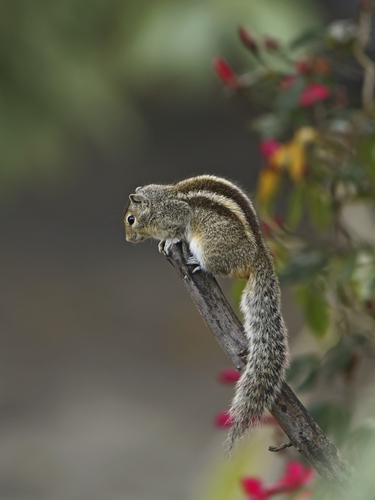
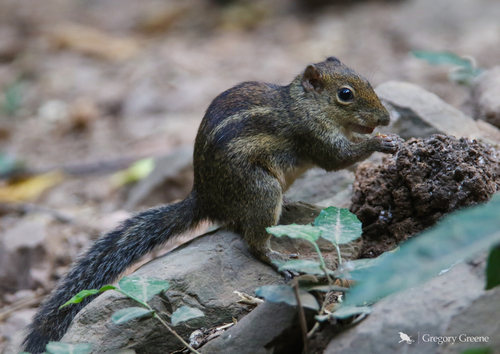
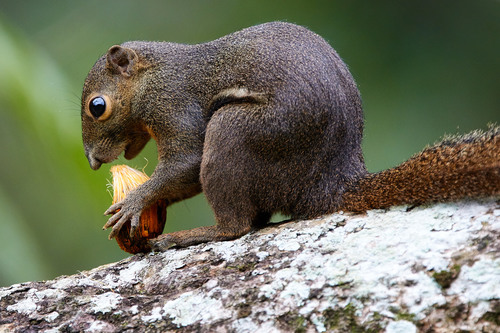
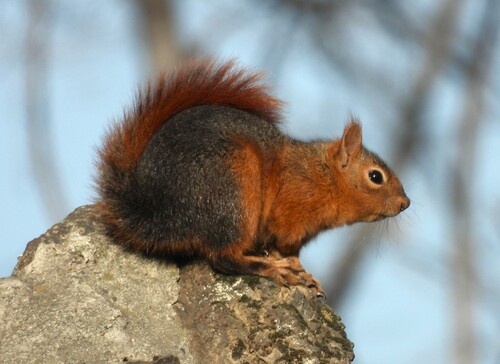
Caucasian squirrels (scientific name: Sciurus anomalus Gmelin, 1778) are small tree squirrels. They have a total length of 32 to 36 cm (13 to 14 in), which includes a 13 to 18 cm (5.1 to 7.1 in) tail, and weigh between 250 to 410 g (8.8 to 14.5 oz). The fur color of the upper body ranges from greyish brown to pale grey, varying by subspecies. The underparts are colored rusty brown to yellowish, and the tail ranges from yellow brown to deep red. Compared to other tree squirrels, Caucasian squirrels have relatively short claws, and females have either eight or ten teats. In 1885, Samuel Griswold Goodrich described the species as having grayish-brown coloration on the upper body, and yellowish-brown coloration on the underparts. Caucasian squirrels are native to south-western Asia. Their range extends from Turkey, and the islands of Gökçeada and Lesbos in the west, to Iran in the southeast, and reaches as far south as Israel and Jordan. It is one of only two species from the genus Sciurus found on Mediterranean islands. Even though Eurasian red squirrels have been introduced to some areas of the region recently, the Caucasian squirrel remains the only native Sciurus species in this wider region. The species primarily inhabits forested areas dominated by oak, pine, and pistachio, and can be found up to altitudes of 2,000 metres (6,600 ft). Three subspecies are currently recognised: S. a. anomalus, found in Turkey and the Caucasus; S. a. pallescens, found in the Zagros Mountains from south-eastern Turkey to Iran; and S. a. syriacus, found in Lebanon, Syria, Israel, and Jordan.