About Sciurus aberti Woodhouse, 1853
Scientific name: Sciurus aberti Woodhouse, 1853
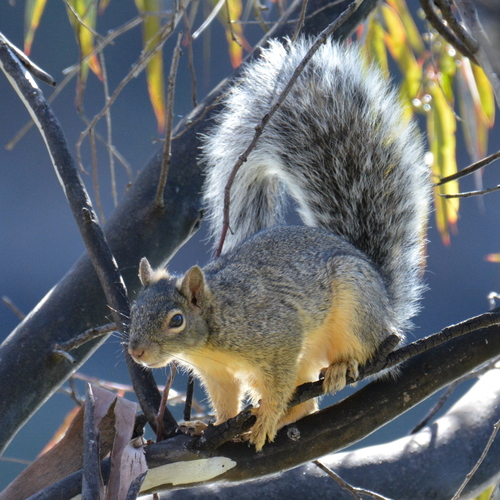
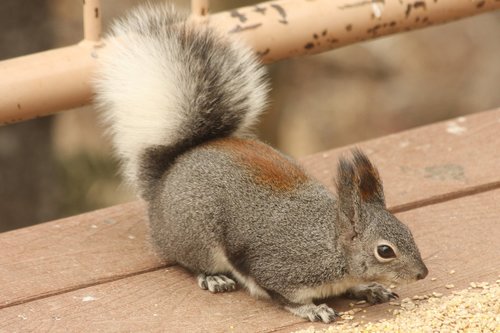
Physical characteristics: Abert's squirrels measure 46–58 cm in total length, with a 19–25 cm long tail. They are easily identified by their 2–3 cm long ear tufts that extend upward from each ear. This trait makes the species closely resemble the Eurasian red squirrel, aside from Abert's squirrel's distinct darker overall coloration.
Abert's squirrels vary in color across their range. Most populations have a gray coat, with a reddish stripe running down the back, a dark stripe along the side, and a white underbelly. Some populations do not have the reddish back stripe, and have fully gray upperparts instead. A fully black color morph occurs in the foothills of the Rocky Mountains in Colorado. Abert's squirrels living on Arizona's Kaibab Plateau, commonly called Kaibab squirrels, have black underparts and a prominent white tail.
Distribution: Abert's squirrel is native to the Colorado Plateau and southern Rocky Mountains of Colorado, Utah, Arizona, and New Mexico. Its range extends south along the Sierra Madre Occidental into Chihuahua and Durango, Mexico. The species also extends north into Wyoming wherever ponderosa pine (Pinus ponderosa) grows. Abert's squirrels transplanted to Arizona's Graham and Santa Catalina Mountains have established stable populations there. Mellott and Choate documented Abert's squirrels in the Spanish Peaks State Wildlife Area, 43 miles (69 km) southeast of the species' previously known range. The distribution of Abert's squirrel subspecies in the Southwest matches the distribution of disjunct ponderosa pine forests. The ranges of the described subspecies are: S. a. aberti Woodhouse, 1853 – northern Arizona; S. a. barberi Allen, 1904 – northwestern Chihuahua; S. a. chuscensis Goldman, 1931 – New Mexico-Arizona border area; S. a. durangi Thomas, 1893 – Durango; S. a. ferreus True, 1900 – Rocky Mountains, central Colorado; S. a. kaibabensis Merriam, 1904 – Kaibab Plateau, northern Arizona; S. a. mimus Merriam, 1904 – New Mexico-Colorado border area; S. a. navajo Durrant and Kelson, 1947 – southeastern Utah; S. a. phaeurus Allen, 1904 – northwestern and southwestern Durango and southwesternmost Chihuahua.
Habitat: In the United States, Abert's squirrels rely almost entirely on ponderosa pine for cover, nesting, and food. In Mexico, where ponderosa pines are not present, the species lives in stands of the closely related Pinus arizonica.
Optimal Abert's squirrel habitat consists of all-aged ponderosa pine stands with trees grouped by even age, at densities of 168 to 250 trees per acre (496–618/ha), with a basal area of 150 to 200 square feet per acre (34.4–45.3 sq m/ha). In optimal habitat, the average diameter of ponderosa pines is 11 to 13 inches (28 to 33 cm), while Gambel oaks have a diameter at breast height (d.b.h.) of 11.8 to 14 inches (30–36 cm). Optimal habitat includes some ponderosa pines over 20 inches (51 cm) d.b.h., which are the best cone producers. Larson and Schubert recorded that ponderosa pines 36 to 40 inches (91 to 102 cm) d.b.h. produced an average of 446 cones per tree per crop. Trees smaller than 24 inches (61 cm) d.b.h. produced fewer than 100 cones per crop.
In central Arizona, Abert's squirrel summer home ranges averaged 18 acres (7.3 hectares), and ranged from 10 to 24 acres (4.0 to 9.7 ha). Home ranges are somewhat smaller in winter. Ramey recorded that the mean spring and summer home range of Abert's squirrel was 20 acres (8.1 hectares) in Black Forest, Colorado. Subadult males had spring home ranges of around 27 acres (11 hectares), and adult females had slightly larger summer home ranges than adult males. Patton documented the home ranges of three squirrels as 10, 30, and 60 acres (4.0, 12.2, and 24.4 ha) in Arizona. Hall recorded an adult female's home range as 29 acres (12 hectares). In Colorado, Ramey found a density of 83 squirrels per square mile (30/km²) in spring 1970, but only 33 squirrels per square mile (12/km²) in spring 1971. In another Colorado study, Farentinos estimated 227 squirrels per square mile (82/km²) in fall 1970, and 317 per square mile (114/km²) in fall 1971.
Ecology and behavior: Abert's squirrels are diurnal. They are often active for a short period before sunrise, active throughout the day in intervals, and usually return to shelter before sunset. Unlike other North American squirrels, Abert's squirrel does not store food. The most common recorded causes of Abert's squirrel mortality are food shortage and injuries such as broken teeth that lead to death.
Reproduction: In central Arizona, breeding takes place from May 1 to June 1, and young are present in nests from June 10 to July 27. Farentinos recorded a 46-day gestation period. Eight observed litters each contained two to five young. Three or four young per litter is typical. Newborn Abert's squirrels are born hairless, with closed ears and eyes. At 2 weeks old, thin short hair is visible, and the ears are slightly open. By 6 weeks old, full fur has developed and the eyes are open. By 7 weeks old, the tail has broadened and is held over the back, and the ears are held erect. By this age, mushrooms and bark have been added to the young squirrels' diet. Captive young squirrels first leave the nest at around 7 weeks, but do not go down to the ground until around 9 weeks. By 10 weeks old, Abert's squirrels are weaned. They reach mature size by 15 to 16 weeks old. Female Abert's squirrels usually only produce one litter per year. However, Hall and Kelson report that two litters per year are common in the southern parts of the species' range.
Food habits: Abert's squirrels feed on ponderosa pine year-round. The parts they eat include seeds, which are their most preferred food, inner bark (especially from young twigs), terminal buds, staminate buds, and pollen cones. Other food sources include fleshy fungi (particularly hypogeous fungi), carrion, bones, and antlers. Severe weather does not always stop the squirrels from feeding. Where Mexican pinyon (Pinus cembroides) seeds are available, Abert's squirrels prefer them over ponderosa pine seeds. Gambel oak acorns may also provide a significant amount of food for the species.
Ponderosa pines produce large cone crops every 3 to 4 years; cones are almost absent in about one out of every four years. Abert's squirrels start eating immature seeds shortly after cone development begins in late May. They continue eating seeds through the summer as cones mature. When seeds are their main food source, a single squirrel may eat seeds from up to 75 cones per day. Seeds are released from cones in October and November. Abert's squirrels continue to eat seeds from late-maturing cones and collect single seeds from the ground after this point. The succulent inner bark of twigs is eaten year-round, but most heavily in winter. To access inner bark, squirrels clip needle clusters from twigs, remove the outer bark, eat the inner bark, then discard the remaining twig. In winter, one squirrel eats about 45 twigs per day. Most feeding trees have a d.b.h. of 11 to 30 inches (28 to 76 cm). After seeds are released, Abert's squirrels depend on inner bark, which makes up the bulk of their diet from November to April. The soft inner tissue of small apical buds is also a preferred food. In May, staminate buds, staminate cones, and immature ovules are eaten when available. New staminate cones are eaten entirely; only pollen is eaten from dried cones. Abert's squirrels also appear to prefer bark from areas of trees infected with dwarf mistletoe.
Fleshy fungi consumed by Abert's squirrels include species from the genera: Agaricus, Amanita, Boletus, Hypholoma, Lepiota, Lycopedon, Russula and Tuber. Mushrooms that are poisonous to humans, including destroying angels (A. bisporigera and A. ocreata) and one species of Russula, are eaten by Abert's squirrels without issue. Abert's squirrels get most of their water from their food, but will sometimes drink from stock ponds or other standing water such as rain puddles.