About Scirtothrips dorsalis Hood, 1919
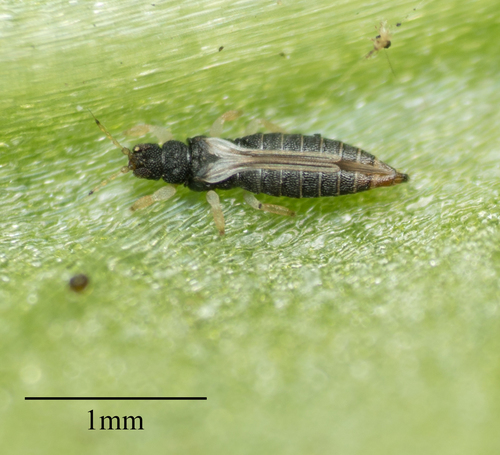
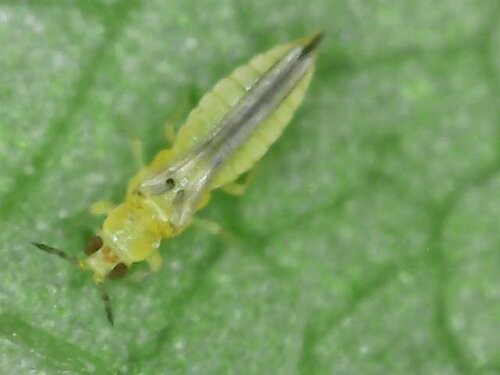
Identification: A tentative but unconfirmed field identification of this thrips can be done by checking for these features under low power magnification: a small size under 1 millimeter in length, yellow body coloration, dark antennae, and dark striping on the lower abdomen. Confirmed, specific identification relies on the presence of these key characteristics: forked sense cones on antennal segments III and IV; pale antennomeres I-II and dark antennomeres III to IX; three discal setae on the lateral margins of abdominal tergites; pronotal posteromarginal seta II that is nearly one and a half times as long as seta I or III; a complete posteromarginal comb on tergite VII; and three ocellar setae, with ocellar seta III positioned between the posterior ocelli. Recent research has concluded that Scirtothrips dorsalis forms a species complex of at least three separate species that are morphologically similar but genetically distinct.