About Scindapsus pictus Hassk.
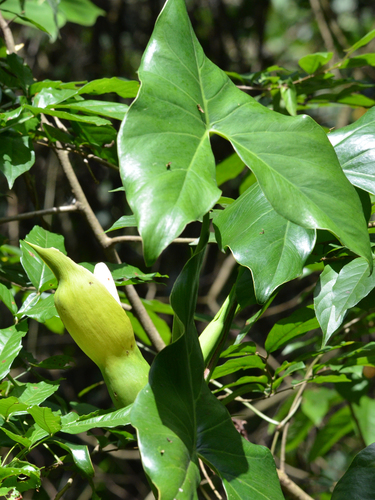
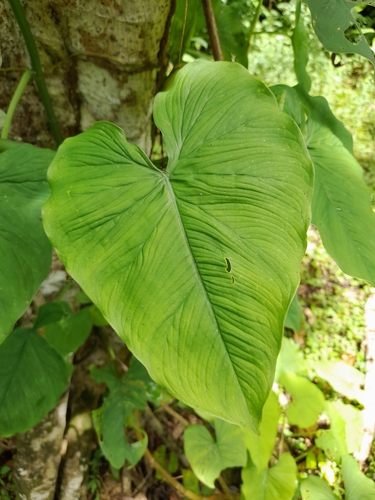
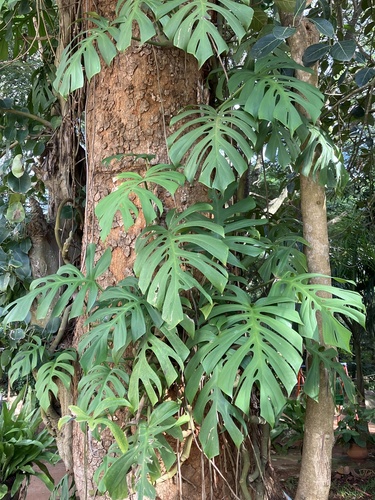
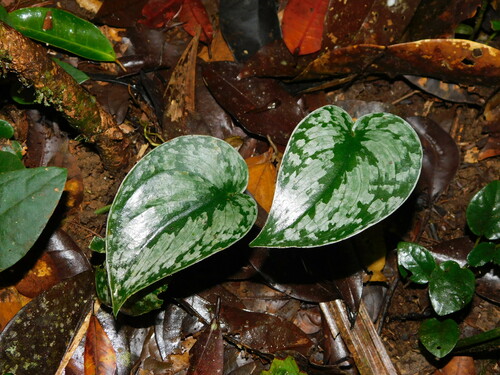
Scindapsus pictus Hassk. is an evergreen climbing liana that can reach around 3 meters (10 feet) in height. It grows upward and outward from its roots, with its newest growth forming at the tip of its vine, which acts as the plant's stem. Nodes form along the underside of the vine, usually spaced a few centimeters apart. These nodes produce anchoring roots that allow the plant to climb higher to access more light. The roots have a sticky texture and adhere to any firm surface, including rocks, cement, brick, logs, and trees. A leaf node typically sits adjacent to each root node, sprouting from the opposite upper side of the vine. Unlike leaves of other closely related genera, leaves of S. pictus have a matte finish and a seafoam-pine green color, and are most often covered in silver variegated blotches. Like other aroid genera such as Epipremnum or Syngonium, the inconspicuous flowers of S. pictus are rarely seen when the plant is grown in cultivation. Vegetative propagation, through methods such as taking cuttings or dividing roots, is the most common way to reproduce this species. This species requires a minimum outdoor temperature of 15 °C (59 °F). It is widely cultivated as a houseplant in temperate regions across the globe, and grown outdoors in climates that meet its temperature needs. It typically grows somewhat slowly, reaching around 90 cm (35 in) under typical conditions. However, when given a suitable support structure such as a building side, wall, tree, or wide pole, S. pictus vines often grow faster and taller as they reach toward sunlight. Mature leaves will eventually "shingle," meaning they grow flattened against the support structure, to maximize photosynthetic exposure while growing beneath a forest canopy.