About Scilla lilio-hyacinthus L.
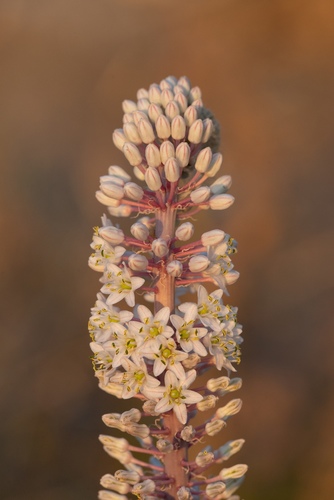
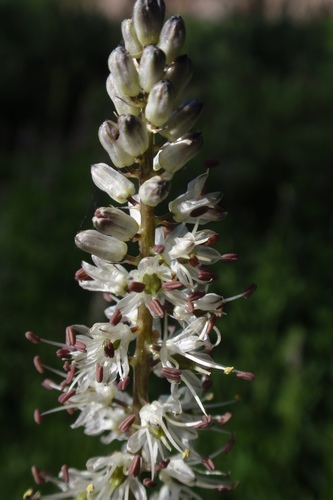
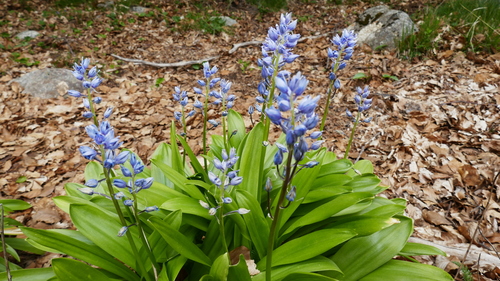
Scilla lilio-hyacinthus L. is a perennial herbaceous geophyte that grows 10 to 30 centimeters tall, often forming clumps. It produces large scaly bulbs, and new growth emerges from these bulbs in spring. It has six to ten simple, linear basal leaves, each 15 to 30 centimeters long and 1 to 3 centimeters wide. The leaves are glossy green, lanceolate, and pointed at the tip. The plant produces two to three flower stems that lengthen as flowering progresses. Around 5 to 15 upright flowers form a dense, cone-shaped racemose inflorescence. The flowers are hermaphrodite, show radial symmetry, and are trimerous, meaning they have parts arranged in groups of three. They have six identical star-shaped perianth tepals, each 9 to 12 millimeters long, obovate in shape. Tepals are most commonly bright blue, lilac, or purple, and are rarely white. The flowers are surrounded by small, narrow membranous bracts; lower bracts are 1 to 2.5 centimeters long, ovate, and membranous. There are six filamented stamens that match the color of the tepals, with dark blue anthers. The fruit produced by this species is a capsule. The natural distribution of Scilla lilio-hyacinthus covers northern Spain, specifically the Cantabrian Mountains and the Pyrenees, and central and southern France's Massif Central. In this range, it grows in beech forests and meadows at altitudes between 600 and 1600 meters. It typically grows in damp terrain such as stream edges, and especially favors calcareous soils. This species flowers from April to June. Pollination occurs via insects (entomogamy), and seeds are dispersed by falling (barochory). All parts of Scilla lilio-hyacinthus are poisonous. It is occasionally grown as an ornamental garden plant, and can tolerate temperatures as low as -20 °C.