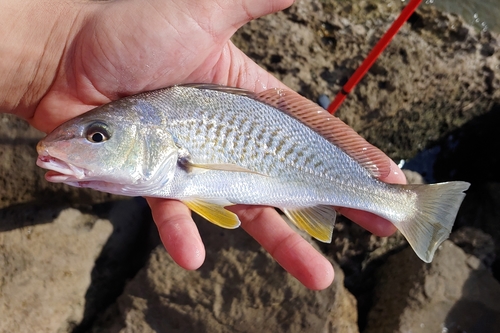
About Sciaenops ocellatus (Linnaeus, 1766)
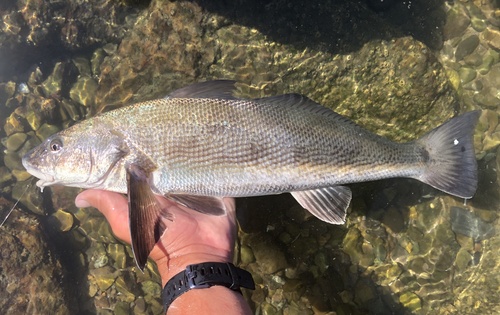
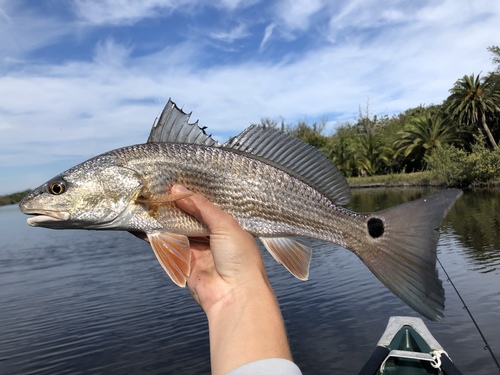
Sciaenops ocellatus (Linnaeus, 1766), commonly called red drum, has a dark red back that fades to a white belly, a streamlined body shape, and a characteristic ocellus (eyespot) near its tail. Three-year-old red drum typically weigh 6 to 8 pounds (2.7–3.6 kg). The largest recorded red drum, caught in 1984 on Hatteras Island, weighed just over 94 pounds (43 kg). During spawning, male red drum produce a knocking or drumming sound by vibrating their swim bladders. The most distinct marking of this species is one large black spot on the upper tail base. Multiple spots are not uncommon, while having no spots is extremely rare; fish with multiple extra spots tend to lose these excess spots as they age. Scientists hypothesize that the black tail spot tricks predators into attacking the fish’s tail instead of its head, helping red drum escape. Red drum locate food using their senses of sight and touch, along with a downturned mouth. They forage on the seabed by vacuuming or biting, and in the upper and middle water column, they target objects that look like food based on light changes. In summer and fall, adult red drum feed on crabs, shrimp, and mullet. In spring and winter, adults feed primarily on menhaden, mullet, pinfish, sea robin, lizardfish, spot, Atlantic croaker, and mudminnows. Red drum naturally occur along the eastern and southern Atlantic and Gulf of Mexico coasts of the U.S. states of Louisiana, Texas, Alabama, Mississippi, Florida, Georgia, the Carolinas, and Virginia. They are a highly prized game fish in the Gulf of Mexico. Aquaculture of red drum is carried out around the world. Multiple individuals have recently been recorded in the Mediterranean Sea off Israel and Sicily, and all are likely escapees from aquaculture operations. Immature red drum prefer grass marsh areas of bays and estuaries when available. Younger mature red drum (3–6 years of age) and large bull red drum prefer rocky outcroppings, plus human-made structures such as jetties, oil rigs, and bridge posts, where they can be found throughout the entire water column. Mature red drum spawn near shorelines from mid-August to mid-October, usually near estuary inlets and passes along barrier island beaches. Males use muscular contractions to vibrate their swim bladders and produce drumming sounds to attract females. A female red drum lays approximately 1.5 million eggs per batch, with a total range from 200,000 to over three million. Red drum eggs incubate for 24 hours. After hatching, larval red drum perform vertical migrations to ride high-salinity tidal currents into tidal creeks and shallow salt marsh nursery habitats. In 2000, Scharf reported that in their first year, young red drum in Texas estuaries grow about 0.6 mm per day; growth rates vary by location and year, and are higher in more southerly estuaries. After their first year, red drum are typically 271–383 mm long. About half of all red drum are able to reproduce by age 4, when they measure 660–700 mm long and weigh 3.4–4 kg. Adults reach maturity between 3–5 years of age; approximate length at maturity is 28 inches for males and 33 inches for females. Red drum can live up to 60 years old. As red drum increase in length, their weight increases exponentially. For nearly all fish species, the relationship between length (L) and weight (W) follows the formula W = aL^b, where b is always close to 3.0 for all species, and a varies between species. In 2004, Jenkins reported slightly different weight-length relationships for red drum caught in spring and fall off the western Gulf Coast of Louisiana: in spring, the formula is W = 0.000005297L^3.110, and in fall it is W = 0.000015241L^2.94, where weight is measured in grams and total length is measured in millimeters. For example, these relationships predict that a 600-mm (just under 2 foot long) red drum would weigh approximately 2300 g (just over 5 lb). These relationships can be used to assess the health of sampled red drum by comparing their actual weight to the predicted weight for their length. Between 1980 and 1988, commercial fishermen harvested an average of 28% of the total red drum catch, while recreational sport fishermen harvested 72%. Catch limits and size restrictions have increased the average weight of red drum caught in Louisiana coastal waters, and restrictions on both commercial and recreational fishing allowed the species population to rebuild. U.S. states adjust recreational catch limits and minimum and maximum lengths to maintain sustainable red drum populations. In October 20, 2007, U.S. President George W. Bush issued Executive Order 13449, which designated red drum as a protected game fish. This order prohibits the sale of red drum caught in U.S. federal waters, and encourages states to designate red drum as a protected game fish within their own state waters. While wild red drum can no longer be commercially harvested in U.S. federal waters or most state waters, they are still commonly caught recreationally and eaten as table fare by many people. Farm-raised red drum remain available as a commercial product. Commercial netting for red drum ended after coastal states such as Florida banned the sale of wild red drum. Recreational size and bag limits have been very effective, so daily catch limits have been increased in recent years.