About Schuchertinia milleri (Torrey, 1902)
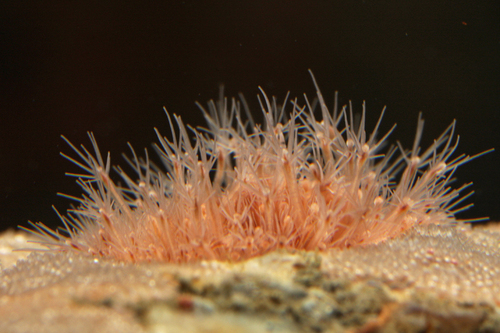
This hydroid species, Schuchertinia milleri, forms colonies from a carpet-like mat of stolons interspersed with long spines. Three different types of polyps grow individually from these stolons: feeding polyps called gastrozooids, reproductive polyps called gonozooids, and finger-shaped polyps called dactylozooids. The stolons have a chitinous covering called perisarc, while the polyps themselves are naked. Pink gastrozooids reach up to 5 mm (0.2 in) in height, with a ring of 12 to 20 tentacles surrounding their mouth. Each entire Schuchertinia milleri colony is either male or female, so all gonozooids in a colony share the same sex. Each female gonozooid contains a single egg. Schuchertinia milleri is native to the northeastern Pacific Ocean, with a range that extends from Vancouver Island to Monterey Bay, California. It lives in the low intertidal zone and shallow subtidal zone, growing on and under rocks and boulders, and also on mollusc shells that are occupied by hermit crabs. Hydroids of this species are sometimes found growing on hermit crab-occupied mollusc shells. One recorded case found a Schuchertinia milleri colony on a shell occupied by the whiteknee hermit crab Pagurus dalli, a species that is more commonly overgrown by a type of sponge. This association appears to be symbiotic: the hermit crab gains protection from the hydroid’s stinging cells, while the hydroid benefits by avoiding burial in sediment and being carried to new feeding locations. When hosting other hydroid species, this hermit crab has been observed wiping the flagellum of its second antenna across the hydroid colony’s surface to collect larger planktonic prey from the epibiont hydroid.