About Schkuhria pinnata (Lam.) Kuntze
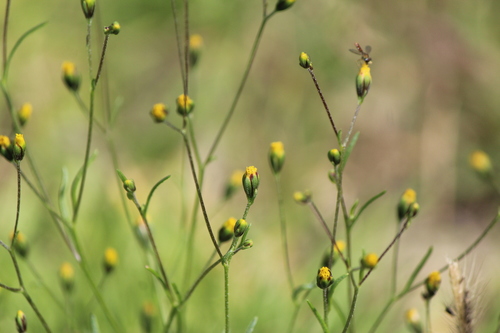
Schkuhria pinnata (Lam.) Kuntze grows 30–60 cm tall, and grows as a pioneer species on disturbed ground including roadsides and ploughed lands. Most of its leaves are pinnatisect, while the upper leaves are simple and filiform. The upper surface of the leaves has narrow grooves, and both leaf surfaces are pitted with many small glands. This species produces numerous small terminal capitula, each containing one solitary ray floret with a yellow 1.5–2 mm long ligule, plus 4 to 6 disc florets. Corollas range from yellow to white, and sometimes carry a purple tinge. The bracts are obovate, with a hyaline apex; their margins are minutely ciliate and glandular-punctate. The achenes are narrow-turbinate, 4-angled, and approximately 4 mm long. There are 8 membranous pappus scales, which are darkly striated at the apex. This plant is native to South America, where it typically occurs in drier mountainous regions between 2000 and 3000 meters in elevation, and grows abundantly in inter-Andean valleys. Currently, it can also be found in Latin America, Mexico, Africa, and the southern United States. Indigenous Quechua (Ketchwa) people of the Andes have a long tradition of using this plant to treat a wide range of conditions and ailments: it is used as a bactericide for open wounds, to treat acne, malaria, and inflammation, and as a blood purifier and diuretic. The plant can also be used as an abortifacient, either by inserting the root or preparing an oral infusion of the whole plant. Studies show Schkuhria pinnata has high antibacterial activity, and dichloromethane extracts from its shoots selectively inhibited COX-1 in an anti-inflammatory assay.