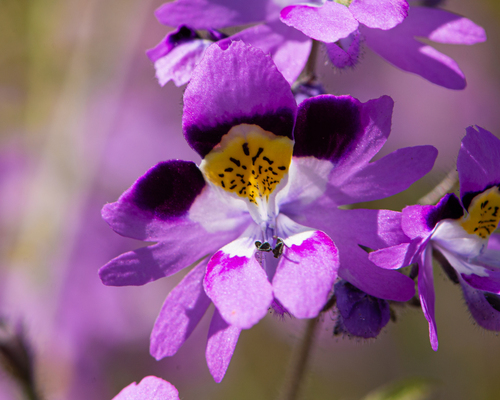
About Schizanthus carlomunozii V.Morales & Muñoz-Schick
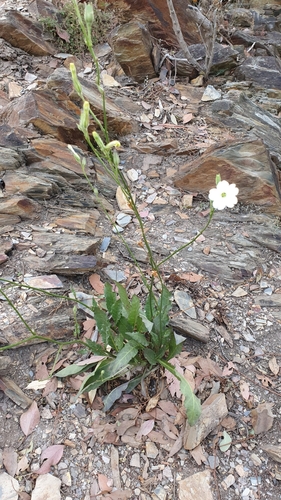
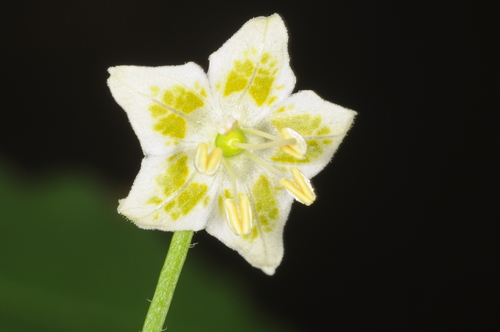
Schizanthus carlomunozii V.Morales & Muñoz-Schick is an annual herb that may develop a woody base. It produces one or multiple stems from a single root system, and the entire plant is usually covered in sticky glandular hairs, along with non-glandular unicellular hairs. Most leaves are bipinnatifid, with irregularly divided segments arranged opposite or alternate to each other, positioned perpendicular to the leaf midrib. The inflorescence is a terminal panicle. Peduncles of the lowest flowers reach 30–40 mm (1.2–1.6 in) in length. Flowers are 5-merous. The calyx is covered in coarse glandular hairs; its fused tube is very short, and extends into 5 slightly unequal segments shaped like lines, spades, or lances. The corolla tube grows up to 3 mm long, which is shorter than the calyx. The corolla is strongly bilaterally symmetric, butterfly-like, and measures 10–34 mm (0.39–1.34 in) long and 10–40 mm (0.39–1.57 in) wide. The upper corolla lip is divided into three lobes. The middle lobe is inverted lance-shaped, with an entire margin and a rounded apex that has a small V-shaped notch, or is bi-lobed or multi-lobed. This lobe has a yellow area dotted with maroon spots, bordered distally by a dark claret-colored zone. The upper lip's side lobes are divided, and their segments may sometimes divide two or more additional times. The upper segments of the upper lip's lateral lobes curve slightly downward and are wider than the lower segments of these lobes. The middle lobe of the lower corolla lip is 4–6 mm (0.16–0.24 in) wide and forms a keel, while the side lobes of the lower lip are linear or spade-shaped, curve inward, and are longer than the middle lobe. The two fertile stamens are enclosed within the keel, and a much reduced staminode may sometimes be present between their bases; two distinct staminodes point outward to the sides or forward. Stamens almost reach the tip of the lower middle corolla lobe. Anthers are basifixed (connected to filaments at their base) and release pollen explosively when touched. A nectar-producing gland circles the base of the ovary. The style is thread-thin, topped by an inconspicuous stigma that lacks papillae. The fruit is a hairless capsule that dehisces (opens) via two valves, and holds up to 40 compressed, ellipsoidal or kidney-shaped seeds. Both recognized varieties of this species are endemic to Chile, occurring at elevations between 20 and 350 m above sea level. Schizanthus carlomunozii var. carlomunozii is found along the coast of the Elqui and Limarí provinces, between 29°35' and 31°10' southern latitude. Schizanthus carlomunozii var. dilutimaculatus occurs from Elqui province to Petorca province, between 29°25' and 32°20' southern latitude. The nominate (typical) variety grows near the sea in the shade of shrubs, along roadsides, on sandy slopes, and in dry fields. Schizanthus carlomunozii var. dilutimaculatus grows in dunes and other sandy soils, in the shade of shrubs, along disturbed roadsides, and on shady slopes. It is found growing near Centaurea chilensis, Myrcianthes coquimbensis, and Heliotropium stenophyllum. Both varieties occur within Fray Jorge National Park.