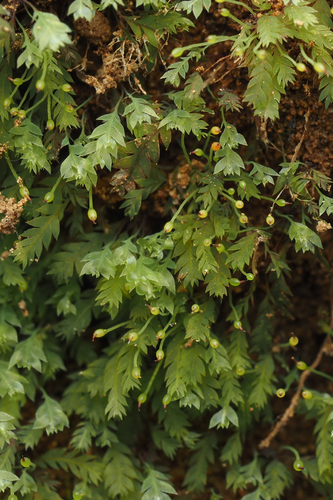
About Schistostega pennata (Hedw.) F.Weber & D.Mohr
This moss is adapted to grow in low-light conditions. Its protonema contains spherical cells that work as lenses, which collect and concentrate even the dimmest available light. The chloroplasts absorb light wavelengths they can use, and reflect the remaining light back toward the original light source; this reflection gives the moss a distinctive greenish-gold glow. These small lens cells can also turn toward the light source to collect as much available light as possible. Shoots that develop from the persistent protonema produce small fronds, which reach 1.5 cm in length and bear opposing pairs of leaves. The egg-shaped spore capsule is held up high by a long stalk. Schistostega pennata is distributed across China, Japan, Siberia, Europe, and North America. In open, brighter areas, it is easily outcompeted by other mosses and plant species, but its light-concentrating ability lets it grow in shady locations where other plants cannot survive. It prefers damp, not waterlogged, mineral soils with a source of dim light, for example light reflected from a pool of water. Because of these preferences, it grows in habitats including overturned tree roots, animal burrow entrances, and caves.

