About Schima superba Gardner & Champ.
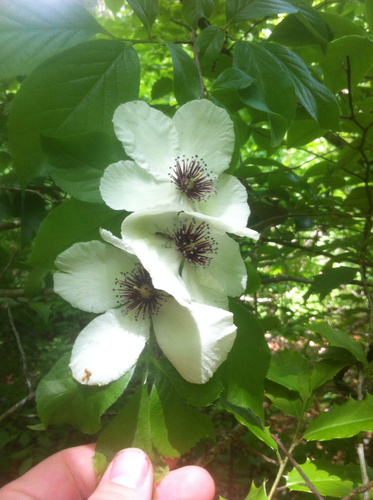
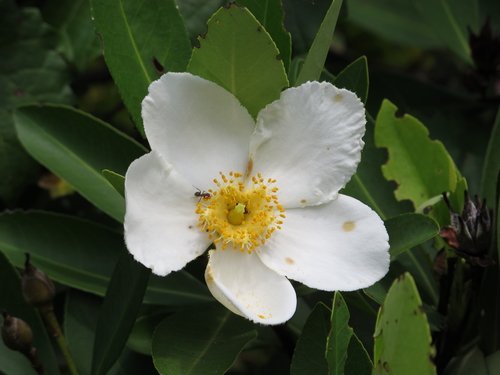
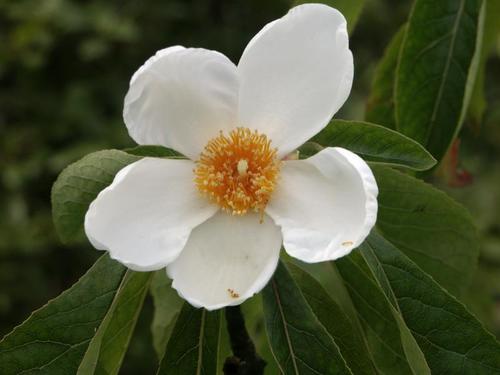
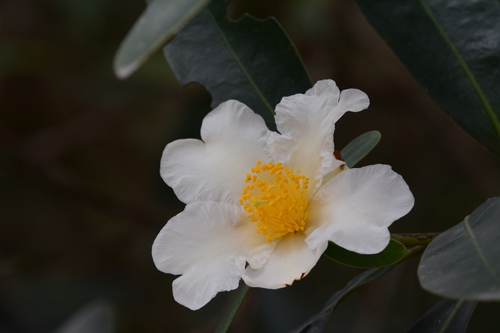
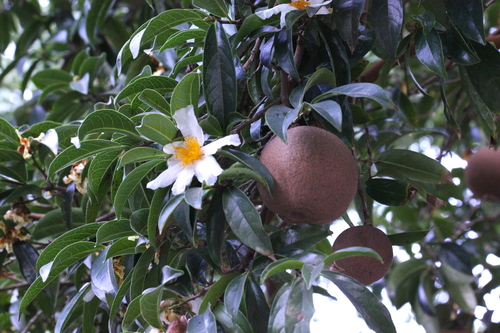
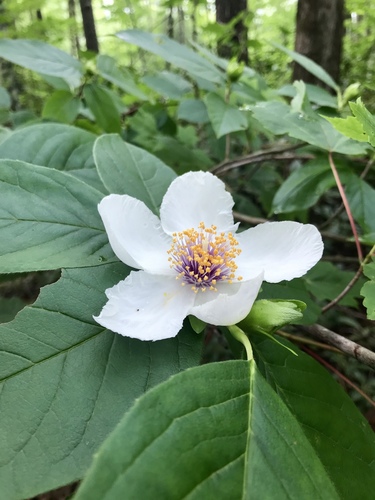
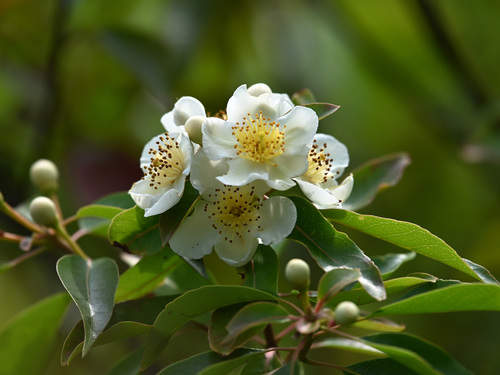
Schima superba Gardner & Champ. is a large evergreen tree with a straight, strong trunk that can reach 30 meters in height, with a diameter at breast height of 1.2 meters. Its leaves are leathery, oval, 7 to 12 centimeters long, and often grow densely at the tips of branches. The fragrant flowers are white, hermaphrodite, 3 centimeters in diameter, and are usually crowded in racemes at the tips of branchlets or in the axils of the top leaves of branches. The fruit is a globose or subglobose capsule. The seeds are small, light, flat and reniform, with narrow wings, and fall easily from the husk. S. superba is an excellent tree species for building fire-proof forest belts in southern China. Its leaves have high water content, a 450 °C ignition temperature, and a low oil content of only 6%, making it non-flammable. It is adaptable, grows rapidly, and has a dense, compact canopy. When the fire-proof forest belt is 14.5 meters wide (four rows) and 5 to 6 meters high, it can stop fire from spreading. Since S. superba often forms forests with Pinus massoniana, Cunninghamia lanceolata and other evergreen broad-leaved trees, it can also provide partial fire-blocking effect. S. superba is an efficient tree for ecological protection in southern China, with excellent water and soil conservation function. It is a deep-rooted species with strong adaptability to soil, and can grow healthily in various acidic soils. It can tolerate drought, barrenness, short-term low temperatures of -10 °C, and 39 °C heat. It is suitable for growing in mixed forests with Pinus massoniana, Cunninghamia lanceolata and other evergreen broad-leaved trees, and is well-suited for low-quality, low-yield forests, as well as for ecological restoration of forest land after bursaphelenchus xylophilus elimination. It is an excellent species for mixed afforestation or as an alternative tree for the second generation regeneration of Cunninghamia lanceolata and Pinus massoniana. The wood of S. superba is hard, dense, less prone to cracking, and easy to process. The wood color is relatively uniform, and the longitudinal cut surface is shiny. It is used to make gunstocks and yarn and cop tubes for the textile industry, and is also used for bridges, ships, buildings, farm tools, furniture, and plywood. The official Chinese name of S. superba is "木荷 mù hé", which translates to tree-lotus. "木荷 mù hé" and "木荷葉 mù hé ye" (tree-lotus-leaf) are both names of traditional Chinese medicines used for external application. The raw material for "木荷 mù hé" comes from the bark, which is said to attack poison and reduce swelling. The raw material for "木荷葉 mù hé ye" comes from the leaves, which are said to detoxify and cure sores. S. superba has an attractive tree shape, large fragrant flowers, and is an excellent landscaping plant. It is also a nectar-producing plant for honey production. Its bark and leaves contain tannins. Research shows the bark may contain toxic substances such as saponin, which are highly toxic to cold-blooded animals, certain insects, and fish, and can be used to develop pesticides.