About Schilbe intermedius Rüppell, 1832
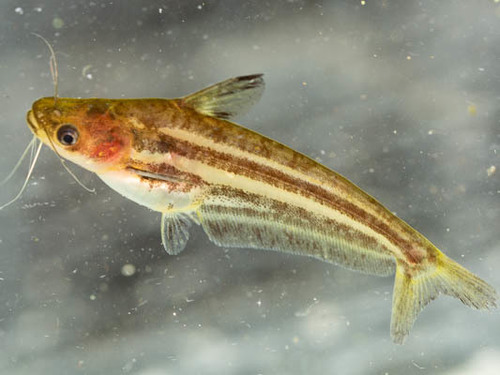
Schilbe intermedius Rüppell, 1832 has two distinct populations: one that lacks an adipose fin, found in northern and western Africa, and one that possesses an adipose fin, found in central, eastern, and southern Africa. This species is quite distinctive. It has a large shovel-shaped mouth surrounded by 4-6 nasal barbs, slightly protruding eyes, and a long anal fin that extends from the vent almost to the caudal fin. It also has four pairs of short barbels around the mouth. The species has a silvery base body color, with brownish to olive coloring on the back and upper parts of the head. Two dark grey to olive bands are present on the body: the longer band runs along the lateral line from the upper gill cover to the caudal peduncle, and a dark humeral spot occurs where this band starts at the upper gill cover. The second, shorter band runs from the base of the pectoral fins to the end of the anal fin. All fins are transparent. The anal fin has a dark band near the body, and a dark streak extends into each lobe of the deeply forked caudal fin. This species is widespread across sub-Saharan Africa, ranging from the Senegal River east to Somalia, and south as far as the Pongola River in South Africa.

