About Sceloporus woodi Stejneger, 1918
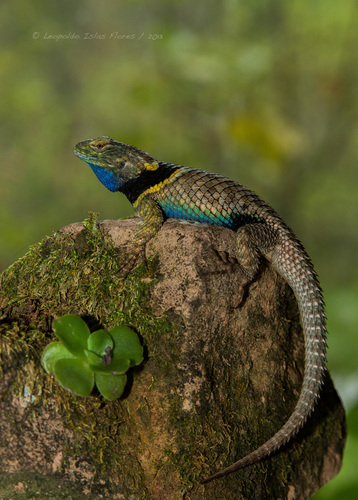
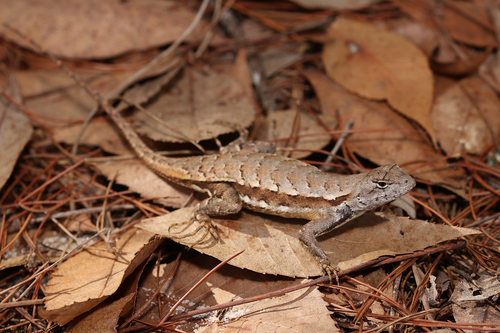
Sceloporus woodi, also known as the Florida scrub lizard, reaches approximately 5 inches (13 cm) in total adult length when including the tail. Its base body color is gray or brownish, with a brown longitudinal stripe running down each side of its body. Males have distinct turquoise patches on the throat and belly. Females usually lack the turquoise throat patches, but may have lighter colored patches on the abdomen. The preferred natural habitat of S. woodi is Florida scrub, which includes both evergreen oak scrub and sand pine scrub. It occurs less frequently in the ecotone between scrub and sandhill habitats, flatwoods, and citrus groves. This species is most abundant in dry habitats that feature open basking areas, nesting space, and nearby pines or oaks that provide shelter. Habitats with a closed canopy are not suitable for S. woodi. S. woodi has a disjunct distribution across four main population areas in Florida: Atlantic coast scrubs, Gulf Coast scrubs, inland central peninsula, and Ocala National Forest and its surrounding areas. It also occurs on the Lake Wales Ridge. While the species is common within Ocala National Forest, its populations are slowly declining across most of its range due to habitat loss. Before intensive development of Florida's scrub zones and sandy ridges, S. woodi was much more widespread across its current range. Habitat loss from development, including the creation of citrus groves, has reduced species populations. Fire suppression causes canopy closure, a habitat change that eliminates the open spaces the species requires for survival. S. woodi has been extirpated from its former range on Florida's Gulf Coast in Collier and Lee County, as well as from Florida's Atlantic coast south of Palm Beach County. This species inhabits widely spaced patches of naturally fragmented scrub habitat, and does not disperse far from its natal area. The main population groups have remained geographically separated for many thousands of years, and this isolation has resulted in high overall genetic diversity across the species. Maintaining this genetic diversity is an important consideration for conservation efforts targeting the species. Courtship and mating for S. woodi takes place in spring. Females bury up to 5 clutches of eggs, with each clutch containing between 2 and 8 eggs. Eggs take approximately 75 days to hatch, and incubation time likely depends on the surrounding ambient temperature. The last hatchlings of the year emerge in November. Individuals reach sexual maturity between 10 and 11 months of age.