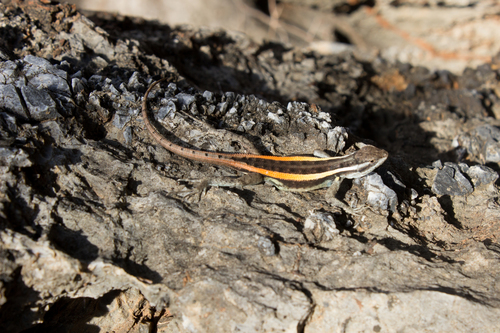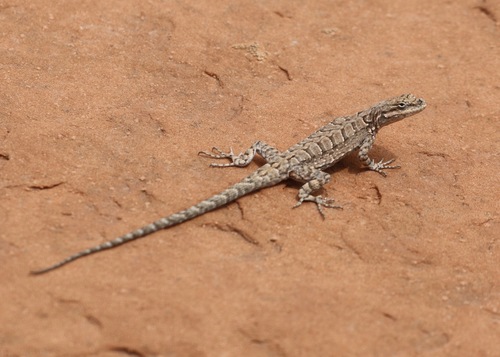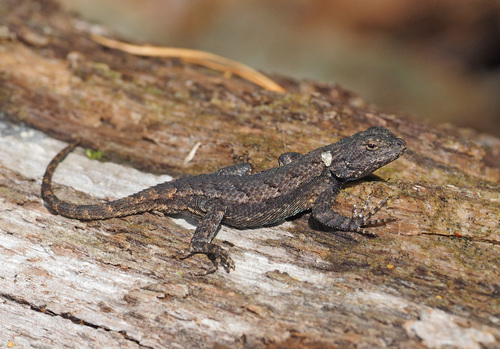
About Sceloporus undulatus (Bosc & Daudin, 1801)
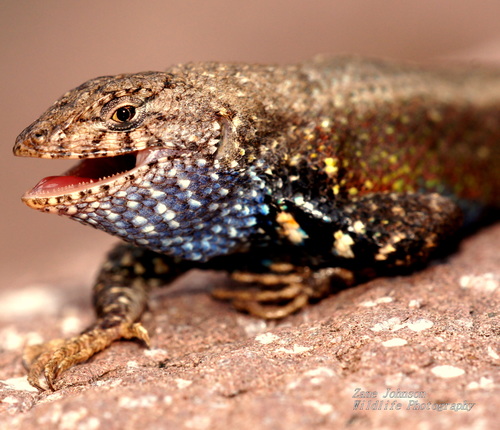
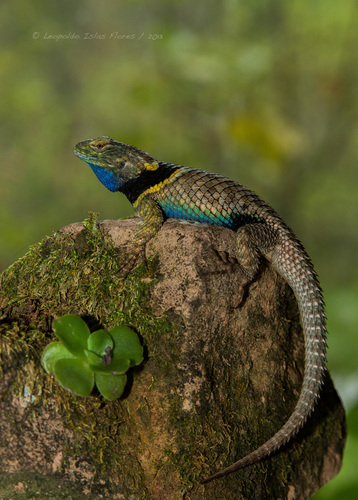
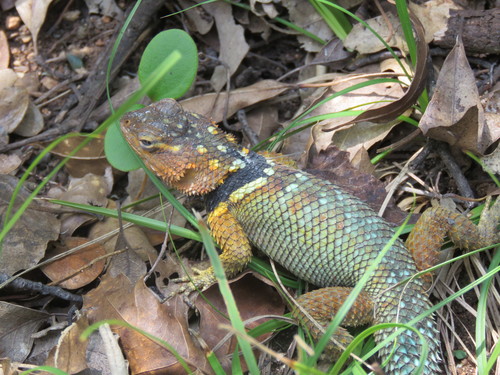
The eastern fence lizard, Sceloporus undulatus (Bosc & Daudin, 1801), reaches a total length including tail of 4.0 to 7.5 inches (10 to 19 cm). Its scales are keeled, and its base coloration is typically gray or brown, with a dark line running along the rear of the thigh. Females are usually gray, with a series of dark wavy lines across the back. Their belly is white with black flecks, and has pale blue patches on the throat and belly. Males are usually brown, and develop more prominent greenish-blue and black coloring on the sides of the belly and throat during summer compared to females. Juveniles resemble females, but are darker and duller in overall tone. Eastern fence lizards mostly live in sparsely wooded areas with ample sunlight, such as pine barrens with sandy or loose soil. They can be found basking on both natural and artificial structures, including coarse woody debris, tree stumps, rock piles, sandy hills, dead logs, and fence posts. They are most active in early morning, before the ground has fully warmed. When temperatures get too hot and at night, they seek shelter and protection under structures like woodpiles, logs, and rocks. The eastern fence lizard is native to Alabama, Louisiana, Arkansas, Colorado, Georgia, North Carolina, South Carolina, West Virginia, Virginia, Indiana, Kentucky, Southern Illinois, Southern Indiana, Tennessee, Ohio, Pennsylvania, Maryland, Missouri, Mississippi, Delaware, northern Florida, southern Wyoming, northeastern Pennsylvania, southern New Jersey, southeastern New York, and southern Connecticut. It prefers open woodland and forest edges, and is often nicknamed the "pine lizard" for its association with pine trees. Adults and juveniles prefer habitats with abundant rocks and coarse woody debris, while hatchlings prefer sites with high temperatures (23 degrees Celsius) and low amounts of litter. There are established introduced populations of eastern fence lizards, the most well-known of which is on Staten Island, New York. In 1942, Carl Kauffeld released 29 lizards near Rossville, where the population still persists today in post oak-blackjack oak barrens. Kauffeld introduced the lizards to have a local, easy source of food for lizard-eating snakes at the Staten Island Zoo, eliminating the need to drive to the Pine Barrens to collect specimens. There have also been sightings of eastern fence lizards in northern Pennsylvania and southern New York, including the Hudson Valley and Long Island, which suggests the species' range may be expanding northward. Despite its broad geographic distribution, eastern fence lizards prefer temperatures that optimize their digestive performance, while their locomotor performance is optimal across a relatively broad range of body temperatures. When climate conditions are stable, eastern fence lizards prefer to sleep in the same site over short periods. The sleeping site is always located within the lizard's home range or territory. When climate conditions are unstable, some eastern fence lizards can survive short frozen periods and return to normal activity once the period ends. For reproduction, females find a suitable nesting location, typically a rotting log or other similarly damp area, to deposit their eggs, and provide no further parental care after laying. Small, young females produce only one clutch of 3 to 16 eggs, while large females can produce up to four clutches per breeding season. Eggs take approximately ten weeks to hatch, and juveniles emerge near the end of summer. Young lizards grow quickly and are able to reproduce the following year. Unfavorable nesting conditions can cause females to retain their eggs longer than usual, a phenomenon called egg retention. In eastern fence lizards, egg retention produces heavier eggs with more developed embryos and higher post-hatching survival rates, but does not affect offspring phenotype. At higher latitudes, eastern fence lizards typically allocate more reproductive energy to first clutches, while at lower latitudes more energy is dedicated to later clutches.