About Sceloporus magister Hallowell, 1854
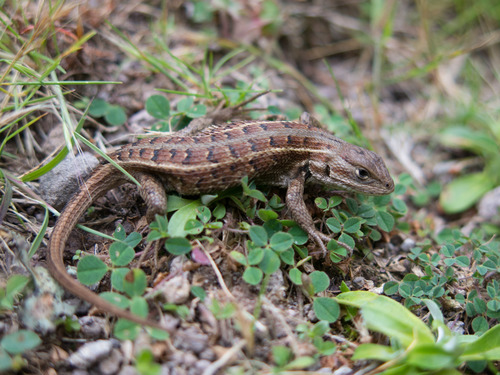
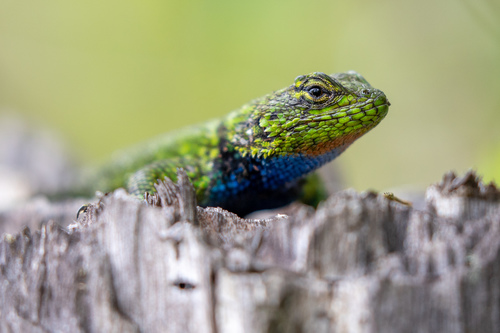
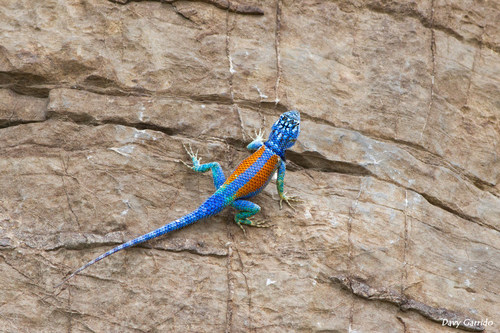
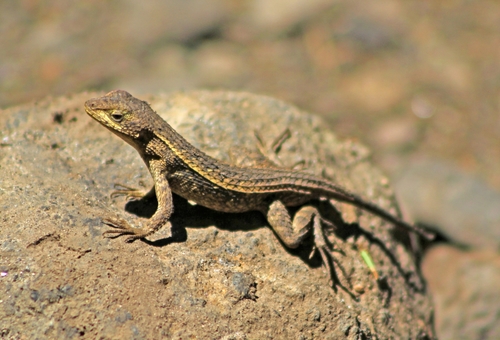
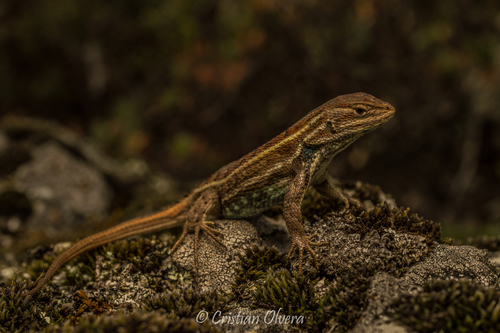
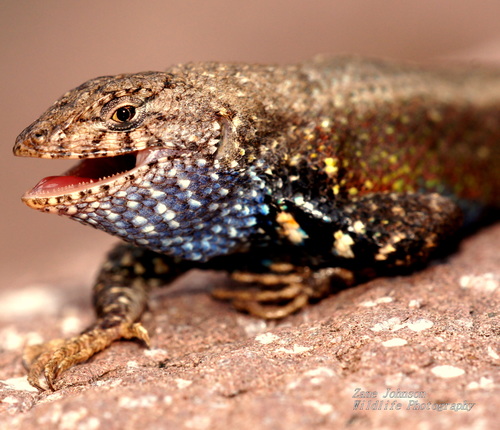
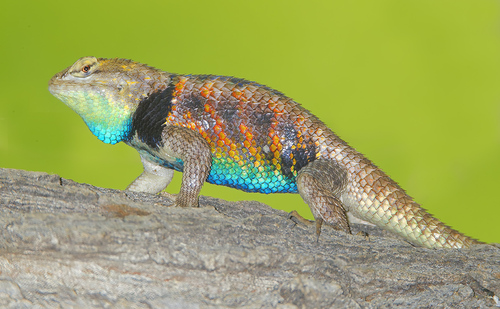
This species, Sceloporus magister Hallowell, 1854, is commonly called the desert spiny lizard. Adult males typically have prominent blue or violet patches on the belly and throat, and green or blue coloring on their tails and sides. Females and juveniles lack this blue/violet and green/blue coloration, and instead have large merged dark spots on their back and belly regions. Individuals of both sexes have brownish or yellow triangular spots on their shoulders. Adult female desert spiny lizards lay between 4 and 24 eggs during the summer. A fully grown desert spiny lizard can reach a body length of up to 5.6 inches. In addition to their distinct bright color patterns, desert spiny lizards change their color: they become darker in winter to absorb more heat from sunlight, and lighter in summer to reflect solar radiation. They are frequently observed doing repeated push-ups (pushing their bodies up and down) as a territorial display. The first recorded case of leukemia in the lizard family Phrynosomatidae was documented in this species. Within the United States, this lizard is found in Arizona, California, Texas, New Mexico, Nevada, and Utah. It also occurs in the Mexican states of Sonora, Baja California, Chihuahua, Coahuila, and Durango. Its distribution extends across the deserts of southern Arizona and the northeastern plateaus, at elevations ranging from near sea level along the Colorado River to approximately 5,000 feet. It inhabits multiple biotic communities, including Sonoran Desertscrub, Great Basin Desertscrub, Semidesert Grassland, Interior Chaparral, and woodlands. It is most often found on lower slopes, bajadas, plains, and low valleys, frequently in tree branches or near ground cover such as wood piles, rock piles, and pack rat nests. The desert spiny lizard is a primarily arboreal species that prefers cottonwood, yucca, Joshua trees, and ironwood.