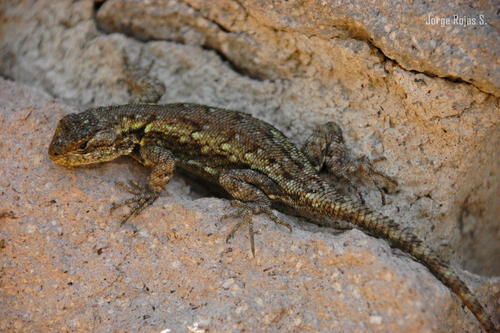
About Sceloporus grammicus Wiegmann, 1828
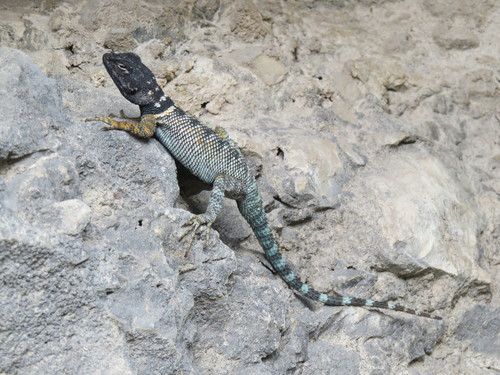
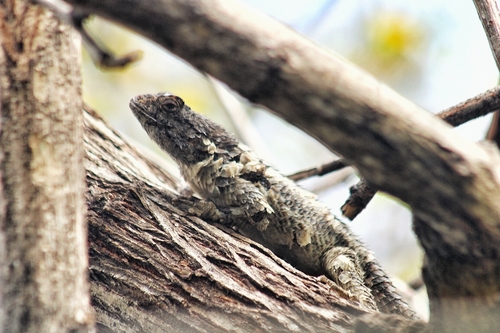
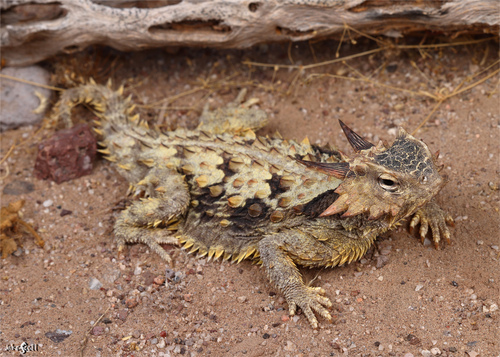
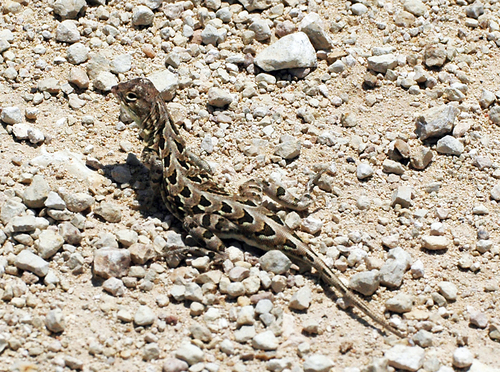
Sceloporus grammicus is a species of lizard first described by Wiegmann in 1828. Individuals of this species have a flattened body, with a tail that is slightly longer than the length of the head and body combined. The total body length of adult Sceloporus grammicus ranges from 10 to 17.5 cm (3.9 to 6.9 in). The upper surface (dorsum) of the lizard is mottled olive or gray, with a pattern of 3 to 6 dark crossbars. Narrow crossbars are also present on the forelegs and tail. Males can be distinguished from females by the presence of blue patches and black mottling on the throat, a dark line on each shoulder, and blue patches on the sides of the belly that are sometimes bordered with black. This lizard is native to southern Texas in the United States, and multiple Mexican states: Chihuahua, Durango, Zacatecas, Coahuila, San Luis Potosí, Nuevo León, Tamaulipas, Oaxaca, Guerrero, Querétaro, and Aguascalientes. Sceloporus grammicus is viviparous (gives birth to live young). Litter sizes for the species range from 2 to 12 offspring. Females reach sexual maturity when their snout–vent length measures between 34 and 74 mm (1.3 and 2.9 in).