About Sceliphron laetum (F.Smith, 1856)
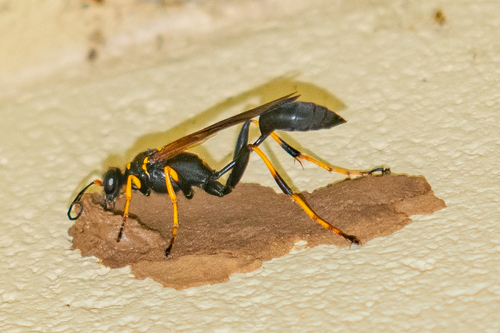
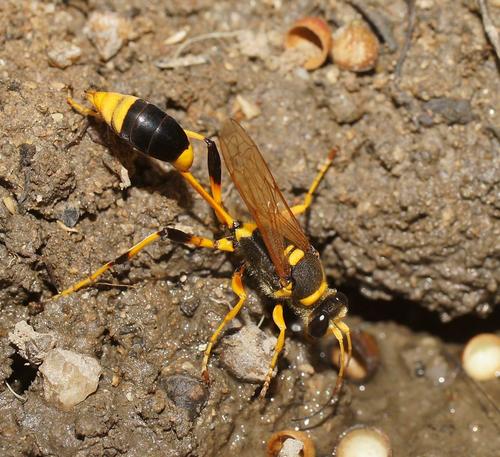
Like other members of the family Sphecidae, the first abdominal segment of Sceliphron laetum has been modified into an elongated, slender petiole. This wasp measures 17 to 26 millimetres (0.67 to 1.02 in) in length, is largely black, and marked with bold yellow patterning. It has membranous wings that fold over its body when at rest. Its head is covered in yellow hairs, which become thinner closer to the ventral side. Unlike the otherwise similar Sceliphron formosum, S. laetum does not have an area of bare yellow skin on the lower part of its face. The thorax has one or more yellow patches on its dorsal side, positioned between the wings. The hind tip of the thorax, the petiole, and the front part of the gaster are yellow; the bulbous central portion of the gaster is black, and its apex is yellow. The legs are yellow with scattered black markings. Sceliphron laetum is native to most of Australia and parts of southeastern Asia including Papua New Guinea. Female S. laetum build multiple cylindrical mud cells that cluster together into a single mass. Once the nest is complete, females add extra mud to create ridges on the nest's exterior. After construction, the female places the paralysed bodies of several spiders into the cell, and lays a single egg on the first spider placed inside. She then seals the cell entrance with mud, and moves on to build and provision an additional new cell. A female's total fecundity is roughly eight eggs. Each larva consumes all of the spiders stored in its cell, then pupates, and finally emerges as an adult by chewing its way out of the cell. This wasp most commonly hunts orb-weaving spiders as prey, and is selective about the species and number of spiders it uses. The egg is frequently laid on a species of Argiope or Neoscona, but these spiders only make up a small percentage of the total prey collected by wasps. The spiny orb-weaver (Gasteracantha) was the most frequently used spider during the later stages of cell provisioning, but eggs are rarely laid on this species. Researchers hypothesize that eggs are laid on comparatively soft-bodied spider species, because the tough spiny abdomen of Gasteracantha would be difficult for an early instar wasp larva to feed on. The number of spiders per cell ranges from three to nine. The wasp adjusts the total number of spiders based on their combined mass, rather than their combined total volume. Wasps control the sex of their offspring when laying eggs. Male wasps of this species are smaller than females, but there is no observable link between the size of a cell's food cache and whether the egg inside will develop into a male.