About Sceliphron curvatum (F.Smith, 1870)
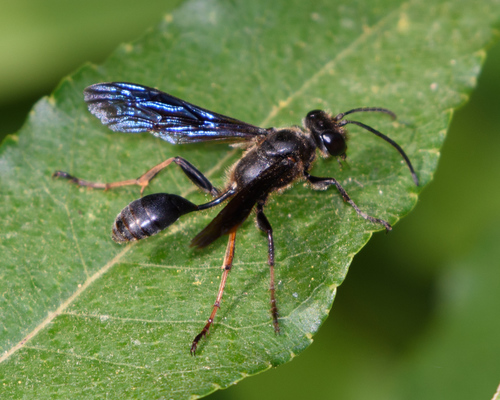
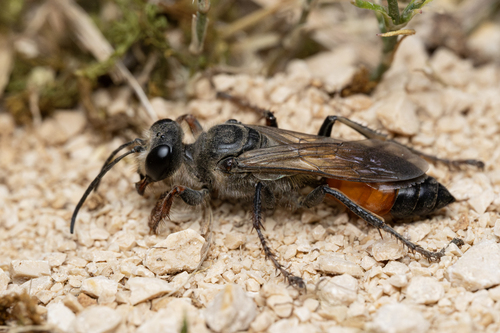
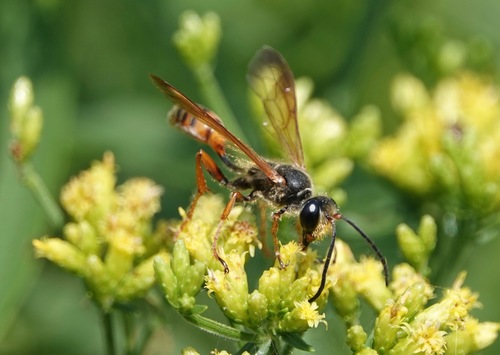
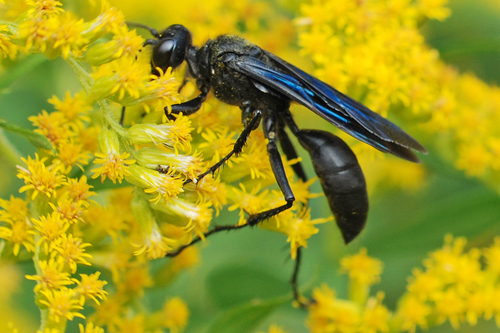
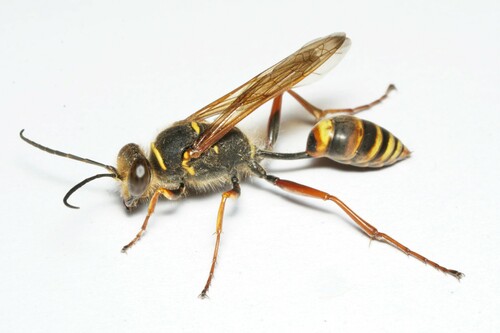
Sceliphron curvatum ranges from 15 to 25 millimetres (0.6 to 1.0 inch) in length, and has a black body with yellow and red markings. This species builds mud nests on the walls of buildings, and also very commonly builds nests indoors on piles of books, clothing, or pieces of furniture. Each nest is stocked with paralyzed spiders that act as food for the species' developing larvae. Like all species in the genus Sceliphron, S. curvatum is not aggressive unless it feels threatened.
Formerly, this species was native to submontane regions of the Himalayas, Karakoram, and Pamir, the world's highest mountain ranges, where it occurred across India, Nepal, Pakistan, Kazakhstan, and Tajikistan. It was first recorded in Europe in 1979, when a female specimen was collected near the village of Grätsch in southeastern Austria. Researchers assume that S. curvatum was introduced to Europe through human activity, but after introduction, the species has spread across the continent on its own. It has rapidly expanded its range, and now forms large established populations in human-associated areas (towns and villages) across southern and central Europe. Since 1979, the species has spread to many additional European countries: Slovenia, Italy, Croatia, Switzerland, France, Hungary, Germany, Serbia, Montenegro, Greece, Czech Republic, Spain, Slovakia, Ukraine, Portugal, Poland, Romania, Belgium, Bulgaria, and Cyprus. S. curvatum has also spread to North America. It was first reported in North America in 2013, and has since spread to multiple U.S. states.