About Sceliphron asiaticum (Linnaeus, 1758)
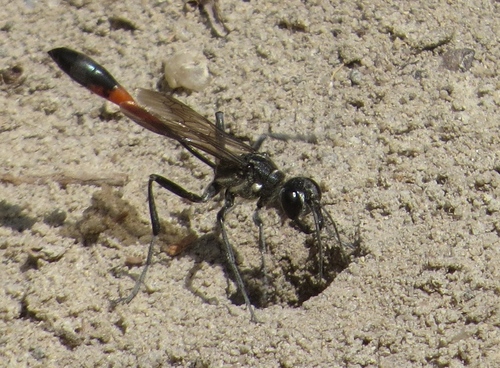
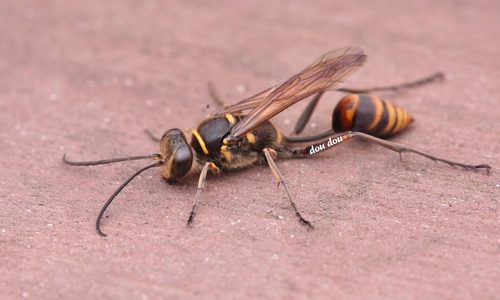
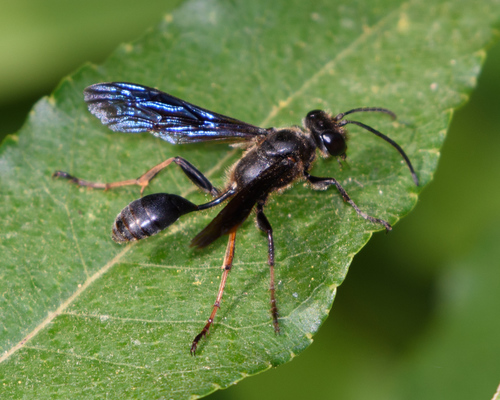
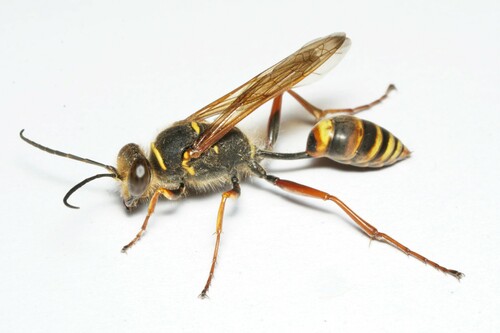
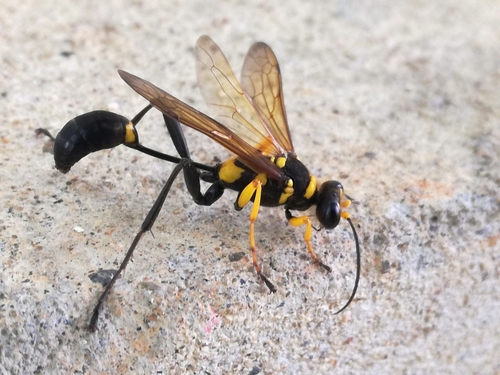
Adult Sceliphron asiaticum have a black head, a black thorax marked with yellow bands, an elongated waist, and a black abdomen, where only the first abdominal segment is yellow. Their antennae are black, their wings are membranous, and their legs show a mix of yellow and black coloration. In Trinidad, S. asiaticum and the related wasp Sceliphron fistularium have overlapping ranges. S. asiaticum typically occupies drier areas with lower forest cover, tends to form denser populations, and its larvae are usually more heavily parasitized. All wasps in the genus Sceliphron collect mud to construct brood cells, where they lay their eggs. Each cell holds one or more paralyzed spiders to act as food for the developing wasp larva. This species shows a relationship between female body size, number of eggs laid, and offspring sex: smaller females lay fewer eggs overall, and a higher proportion of these eggs develop into male offspring, a pattern that maximizes the female’s reproductive success. Melittobia asiaticum is a known parasitoid of S. asiaticum. This parasitoid is between 1 and 1.5 mm (0.04 to 0.06 inches) long, and it causes substantial mortality among S. asiaticum larvae. One mud nest of S. asiaticum was collected from a house in northeastern Brazil. This nest was built from sandy silt, incorporated detritus and faeces, and contained twelve chambers. Each chamber had been provisioned with spider body parts and held a single S. asiaticum larva. All of these larvae were parasitized and killed by M. asiaticum, leaving only dry pupal husks. More than 100 adult M. asiaticum emerged from the nest, with no adult S. asiaticum emerging at all. All of the spiders used to provision the nest chambers were cursorial (running) spiders, and no orb-weaver spiders were found, which was an unexpected result.