About Scatophagus argus (Linnaeus, 1766)
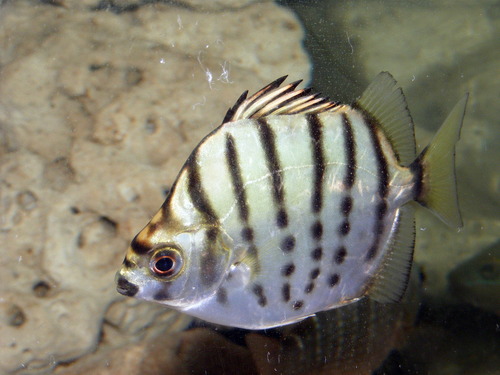
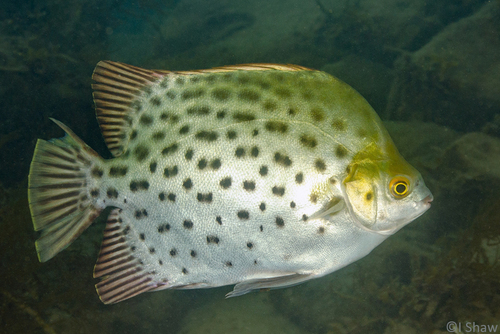
Scatophagus argus (Linnaeus, 1766) has a rectangular, strongly compressed body, with a steep dorsal profile on the head. It has a moderately large eye, whose diameter is noticeably smaller than the length of its rounded snout. It has a small, horizontal mouth that is not protractile, and multiple rows of small bristle-like teeth line the jaws. The dorsal fin has 10 to 11 spines and 16 to 18 soft rays, while the anal fin has 4 spines and 13 to 15 soft rays. A deep notch separates the spines and rays of the dorsal fin, and the first dorsal spine lies flat against the body. The rear margins of the soft portions of both the dorsal and anal fins are roughly vertical. The caudal fin is rounded in juvenile individuals, and becomes truncate to weakly emarginate in adults. The entire body is covered in small ctenoid scales. Adult body coloration ranges from greenish-brown to silvery, marked with many brown to red-brown spots. Juveniles are greenish-brown, and display either a small number of large, dark, rounded blotches, or five to six dark vertical bars. This species reaches a maximum total length of 38 cm (15 in).
Scatophagus argus has a wide distribution across the Indo-Pacific region. It occurs from the Persian Gulf, along the south Asian coast, and extends into the western Pacific. Its range reaches as far north as Japan, and as far south as New South Wales, New Caledonia, and Fiji. It has also been recorded from French Polynesia. A small population is thought to have become established in the Mediterranean Sea near Malta, after the first report of the species there in 2007; this introduction is likely the result of release from aquarium fish keeping. It inhabits sheltered, shallow coastal environments, including estuaries, harbours, mangrove pools, and the lower reaches of freshwater streams, and is especially common in areas with high mineral concentrations. Very young juveniles float within the surface film of the water.