About Scathophaga stercoraria (Linnaeus, 1758)
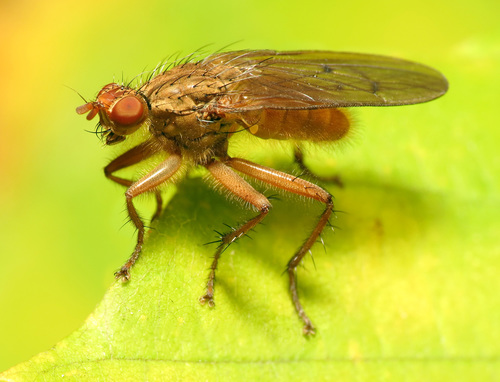
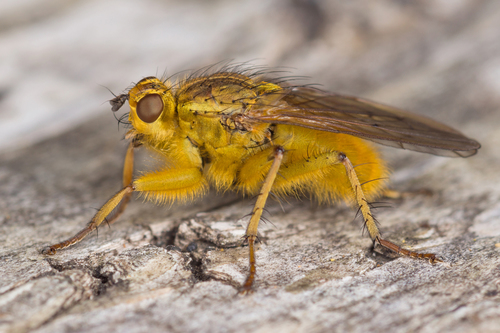
Scathophaga stercoraria (Linnaeus, 1758), commonly called the yellow dung fly, is a sexually dimorphic species with an average adult lifespan of one to two months. Adult males have bright golden-yellow coloration and orange-yellow fur on their front legs, while females have duller coloration with prominent green-brown tinges and lack brightly colored fur on the front legs. Adults range from 5 to 11 mm in total length, and males are generally larger than females. Physical traits can vary greatly between separate populations of S. stercoraria, partially due to the broad range of habitats the species occupies. The species is generally found in cooler temperate regions across North America, Asia, and Europe, and often favors higher altitude sites such as the Pyrenees and Swiss Alps. The phenotype of S. stercoraria varies seasonally, by latitude, and by altitude as an adaptive response to development time constraints imposed by changing temperatures. In autumn, as temperatures cool, the flies increase their development rate to reach a functional though smaller than average body size. Development rate also increases with increasing latitude, which is likely an adaptive response to shorter mating seasons. Only body size, not development rate, varies with altitude: S. stercoraria are larger at higher altitudes due to colder local temperatures. S. stercoraria breeds on the dung of a wide range of large mammals, and generally prefers fresh cattle dung. The operational sex ratio on dung pats is heavily male-biased, leading to high intrasexual competition. Females are smaller than most males and have limited precopulatory mate choice. Copulation lasts between 20 and 50 minutes; after copulation, the male attempts to guard the mated female from other males. Both males and females frequently mate with multiple partners. Reproductive success depends on multiple interacting factors including sperm competition, individual nutrition, and environmental temperature. Females lay their eggs on dung, and eggs hatch into larvae 1 to 2 days after laying, depending on environmental temperature. Newly hatched larvae quickly burrow into the dung for protection and feed on the dung itself. At a constant temperature of 20 °C, larvae undergo three molts over five days of exponential growth. After finishing growth, larvae spend an additional five days emptying their stomachs without gaining any new body mass before pupation. After this preparatory period, larvae burrow into the soil beneath and around the dung to pupate, a process that takes 10 to 20 days total. The time required for juvenile adult flies to emerge after pupation varies from 10 days at 25 °C to 80 days at temperatures at or below 10 °C. Smaller females typically emerge a few days earlier than males. The fitness of emerging juvenile flies depends heavily on the quality of the dung they developed in. Key factors affecting dung quality include water content, nutritional content, presence of parasites, and residual drugs or other chemicals from the host mammal. Yellow dung flies are anautogenous: individuals must feed on prey to acquire enough proteins and lipids to reach sexual maturity and produce viable eggs or sperm. Females experiencing nutritional stress have higher egg mortality rates and lower offspring survival to adult emergence. Over their lifetime, female S. stercoraria produce between 4 and 10 clutches of eggs. Adults remain active through most of the year in most moderate climates. The viability of yellow dung fly populations is strongly dependent on environmental conditions. In warmer climates, sharp population declines often occur in summer when temperatures rise above 25 °C. No such summer population decline is observed in colder climates like those of Iceland, Finland, and northern England, or at high elevations. The number of generations per year also varies with altitude and latitude, typically falling between two and four overlapping generations. The end of winter synchronizes the first adult emergence in March, and overwintering generations are produced in autumn. In northern Europe, where the mating season is shorter, only one or two generations occur per year. Like Drosophila melanogaster, the yellow dung fly is an ideal model organism for research due to its short lifespan and high susceptibility to many types of experimental manipulation. Early research interest in yellow dung flies stemmed from their potential use as biological control agents against pest fly species that impact livestock. In just the past 40 years, S. stercoraria has been used in hundreds of studies researching topics including sperm competition, mating behavior, sexual conflict, reproductive physiology, thermal biology, and genetics. Research on this species has contributed substantially to scientific understanding of multiple mating systems and sperm competition. Recently, S. stercoraria was approved as a standard required test species for ecotoxicological testing, including evaluation of veterinary drug residues in livestock dung. Yellow dung flies play a key role in decomposing waste in pastures, a process that prevents the spread of endoparasites and returns nutrients to the soil. Their predatory diet also reduces the population size of pest fly species. For ecotoxicological toxicity testing, the test chemical is mixed with bovine faeces, and yellow dung fly eggs are added to the mixture. Researchers then measure and analyze endpoints including the sex and number of emerged adult flies, delays in emergence, morphological changes, and developmental rate to determine the chemical's toxicity. A large body of research exists on the effects of avermectins on S. stercoraria populations. Avermectins are used to control endoparasites in livestock, and residual drug remains in the animals' dung. These residues can have unintended adverse effects on yellow dung fly populations, including increased mutation rates and reduced offspring viability. Without careful monitoring of avermectin use in agriculture, considerable economic losses may occur.