About Scarus taeniopterus Lesson, 1829
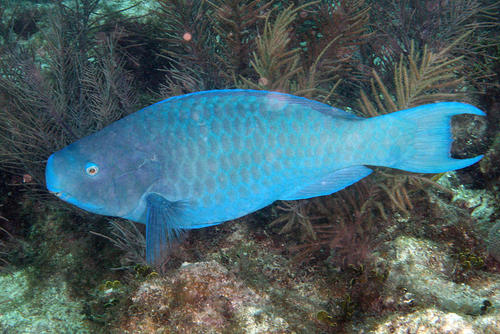
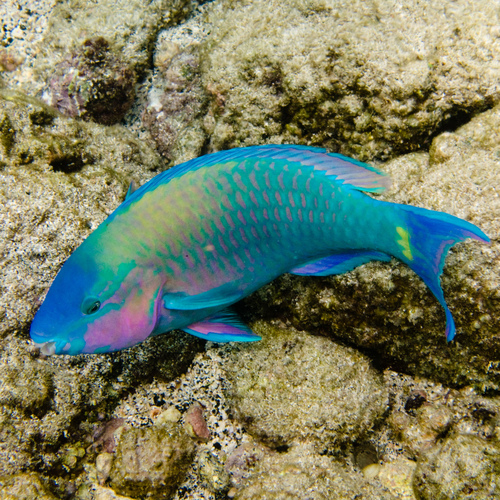
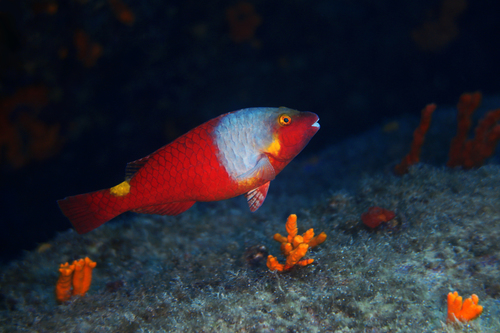
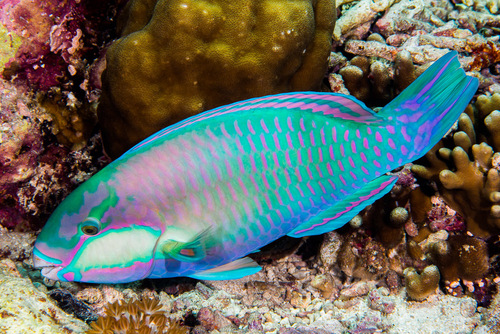
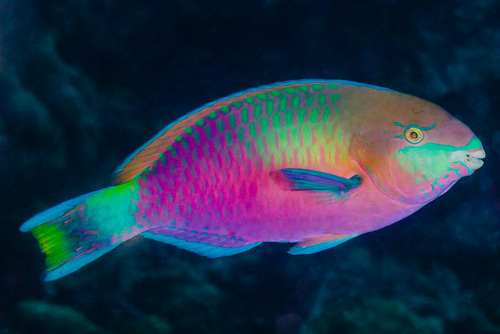
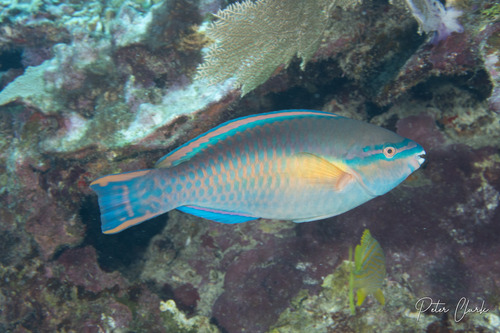
Scarus taeniopterus Lesson, 1829, commonly called the princess parrotfish, is a member of the parrotfish family Scaridae. Like all parrotfishes, it has a fused beak-like jaw formed from its teeth, which it uses to crush and grind food. It also has a second set of teeth called the pharyngeal jaw located in its throat. This species has smooth-edged cycloid scales, and its body coloration differs by gender: males have a blue body with yellow shading across it, while females are white with orange and brown shades.
Members of the Scaridae family play important ecological roles and support commercial fisheries, forming a significant part of coral reef food chains. To get nutrition, these fish scrape surfaces and excavate calcareous structures, and they exert top-down control on algae. When parrotfish are overfished in a habitat, algal biomass increases. When overfishing does not occur, parrotfish grazing helps maintain healthy coral reefs. Populations of Scaridae can be found on the Northern Great Barrier Reef, in the Bahamas, and in the Caribbean. They prefer to graze in shallow sunlit areas where coral grows, favor coral reef habitats, and can also be found among seagrasses. Parrotfish abundance decreases as latitude decreases. In regions with larger predator populations, there is a positive correlation with parrotfish diversity.
Over recent years, increasing disturbances including coral bleaching events have affected parrotfish assemblages. Recent research indicates that these disturbances can increase parrotfish abundance, because they create bare substratum where successional microbial communities can establish. For this reason, ongoing monitoring of coral reef habitats is important.
Scarus taeniopterus spawns year-round during periods of low sunlight, with peak spawning occurring in the summer. There is no documented evidence of parental care for this species. After fertilization, parrotfish eggs are dispersed by tidal currents and typically hatch one day after fertilization. Young fish develop quickly, reach maturity in a few years. Parrotfish have a maximum recorded lifespan of 20 years, though most individuals live 5 years or less. The Scaridae family has complex reproductive systems: males may be born male, or develop from females that change sex depending on local reproductive circumstances, when switching sex provides an advantage.