About Scarus psittacus Forsskål, 1775
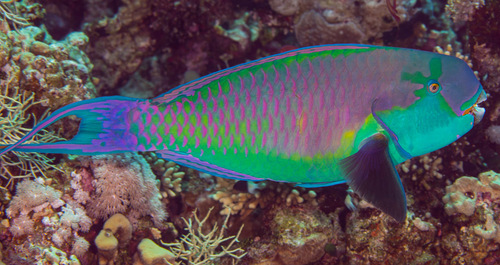
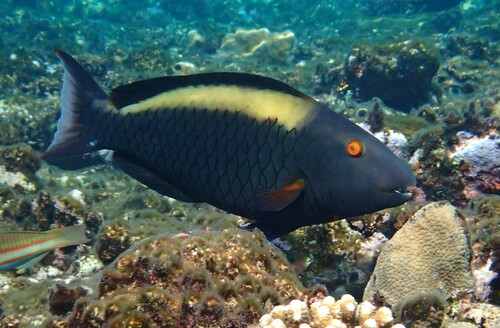
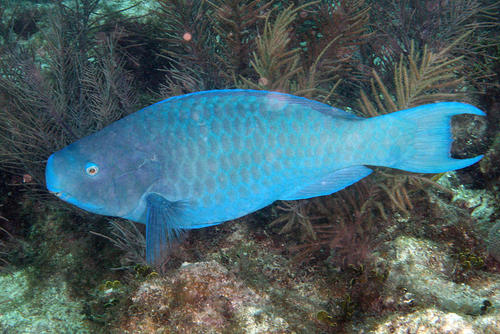
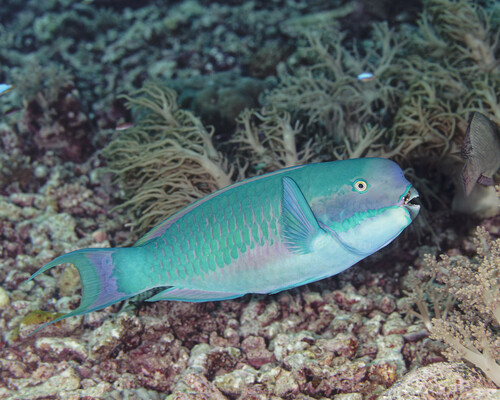
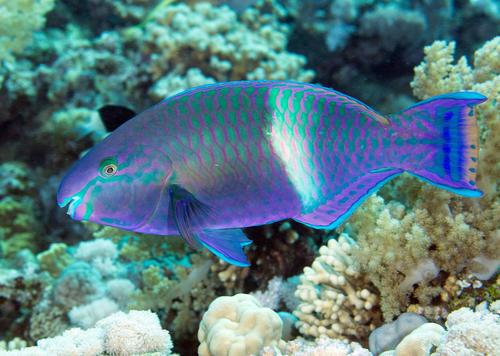
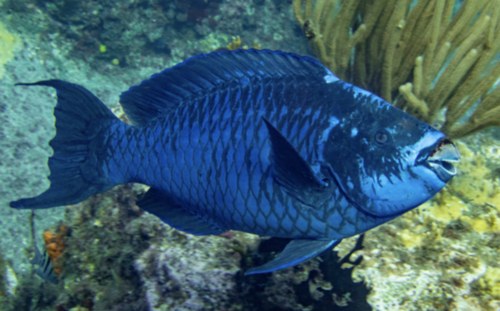
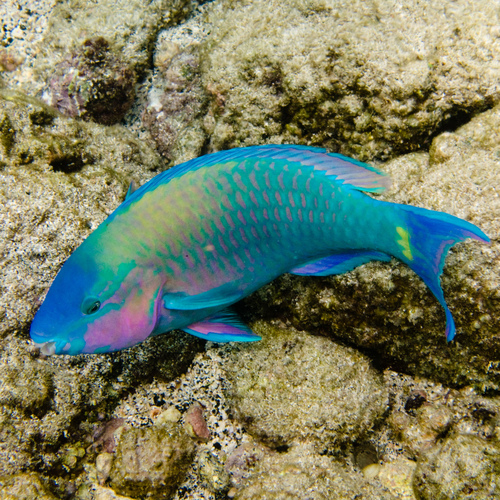
Scarus psittacus Forsskål, 1775 reaches a maximum standard length of 30 centimetres (12 in). Its dorsal fin has 9 spines and 10 soft rays, while the anal fin has 3 spines and 9 soft rays, and the pectoral fin has 13 to 15 rays. This species' lips largely cover its dental plates. Individuals in the initial life phase have one canine-like tooth on their upper dental plate; in the terminal phase, individuals have two canine-like teeth on the upper plate and one such tooth on the lower plate. Terminal phase individuals have a deeply emarginate caudal fin. Initial phase Scarus psittacus are uniformly red-brown, marked with multiple pale blotches and a distinctively pale head. Terminal phase individuals are mainly pale green to tan, with a lavender face and blue bands above the upper lip that extend backward across the cheek below the eye. They also have a second green band behind the eye, and additional bands on the lower lip and chin. Scarus psittacus is widespread across the Indian and Pacific Oceans. Its distribution reaches from the Red Sea, Persian Gulf and Gulf of Aden to Sodwana Bay, extending eastward across the Indian Ocean into the Pacific Ocean as far east as Hawaii, north to southern Japan, and south to Australia, reaching as far south as Shark Bay in Western Australia and Lord Howe Island. This is a common, typical parrotfish species found on reef fronts, more sheltered reef areas, and lagoons. It occurs at depths down to 30 metres (98 ft). It can be found in small schools foraging over corals, lagoon reef flats, and seaward reefs that have abundant growth of the filamentous algae it feeds on. Like most parrotfish species, Scarus psittacus is a protogynous hermaphrodite and is sexually dichromatic. Its populations are structured around a small number of large, colorful territorial terminal phase males that guard groups, or harems, of smaller, less colorful initial phase individuals. Most initial phase individuals are females, but approximately one quarter of initial phase individuals caught off Oahu were males. These are "sneaker males" that join matings between terminal phase males and females, and attempt to inseminate some of the laid eggs. Terminal phase males usually begin life as females: when a harem has no terminal male, the dominant female transforms into a male. Initial phase males are male for their entire lives, and may occasionally transition to become terminal phase individuals.