About Scarus niger Forsskål, 1775
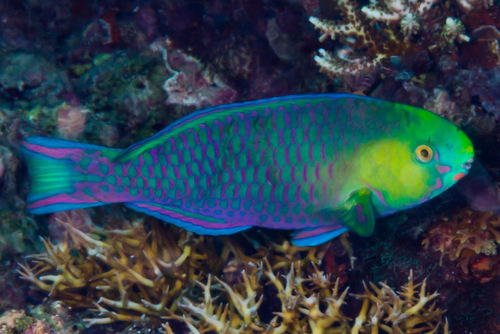
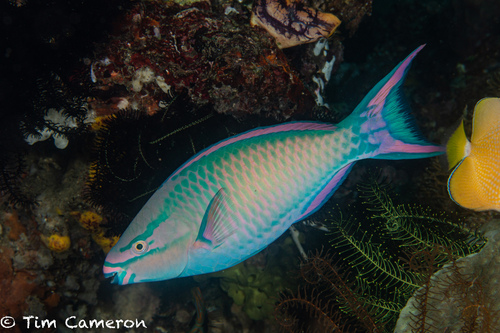
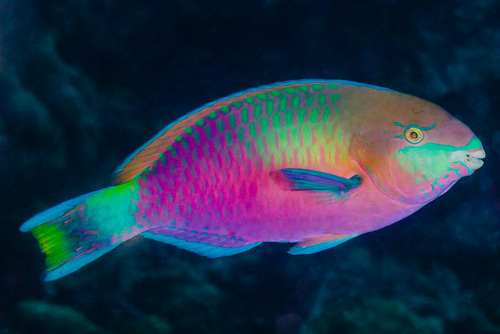
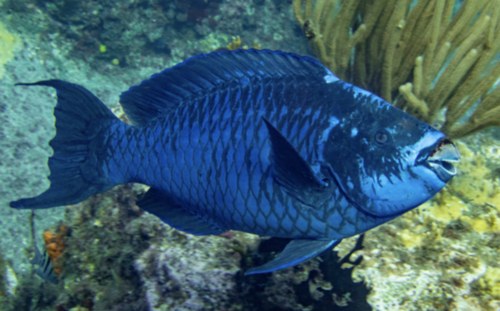
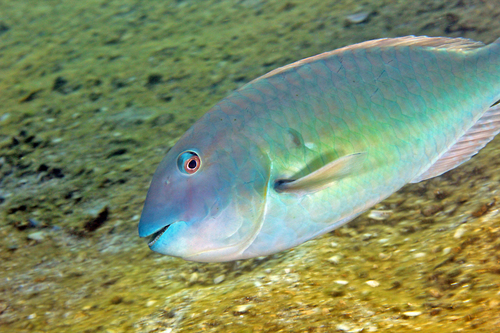
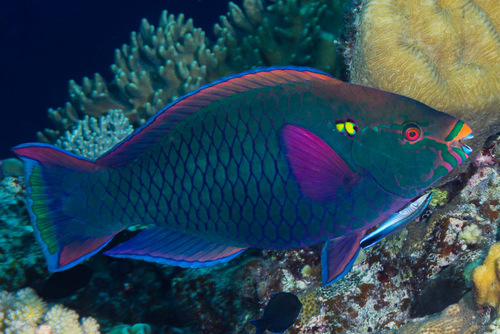
Scarus niger, commonly known as the swarthy parrotfish, dusky parrotfish, and black parrotfish, is a species of parrotfish in the family Scaridae, class Actinopterygii, and phylum Chordata. Like other parrotfish in the Scaridae family, it has a characteristic fin structure: 10 dorsal soft rays, 9 dorsal spines, 9 anal soft rays, and 3 anal spines. This species is distributed across the Indo-West and Central Pacific, ranging from the Red Sea north to Japan, south to Australia, and east to French Polynesia. It inhabits lagoons, channels, and outer reef slopes at depths between 2 and 20 metres (6 ft 7 in to 65 ft 7 in), and also lives in coral-rich reef areas including reef flats and reef slopes. The dusky parrotfish is most often solitary, though males may also live in small groups of mating females. It is primarily herbivorous, feeding mainly on benthic algae. At maturity, individuals are typically 230 to 240 millimetres long and weigh approximately 240 grams. This species is not heavily fished, so its population trends are most likely shaped by habitat availability and recruitment. The dusky parrotfish is a protogynous hermaphrodite; this has been confirmed by observations of dominant females in all-female groups transitioning into males. It is oviparous: during breeding, males and females form pairs, and females lay eggs that later hatch. Its reproductive cycle is marked by changes in gonad size and appearance that correspond to five maturity stages. At full maturity, gonads average 2.54 grams in weight. After breeding, gonads regress to an average weight of 0.37 grams, meaning non-breeding gonads are less than one fifth the size of breeding-season gonads. Dusky parrotfish release only one batch of eggs per breeding season. The presence of swarthy parrotfish in both small and large reef communities supports reef diversity and overall ecosystem resilience. Without this species, reef ecosystems can undergo dramatic shifts. Following extreme climate events such as cyclones, subtle changes occur in reef dynamics, including grazing activity by herbivorous fish. Between 2011 and 2012, after severe climate disturbances, grazing by herbivorous fish including the swarthy parrotfish dropped by more than 90%. While these changes were not immediately visible, they left reef ecosystems highly unstable, with many at risk of collapse. Reduced grazing can lead to the growth of algal turfs that the swarthy parrotfish cannot eat.