About Scarus globiceps Valenciennes, 1840
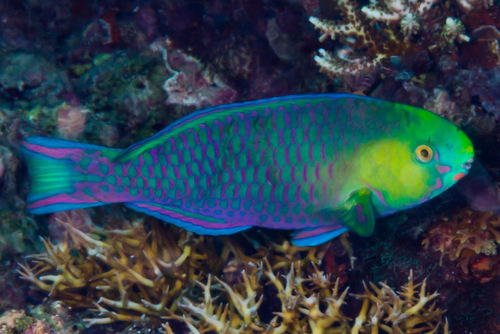
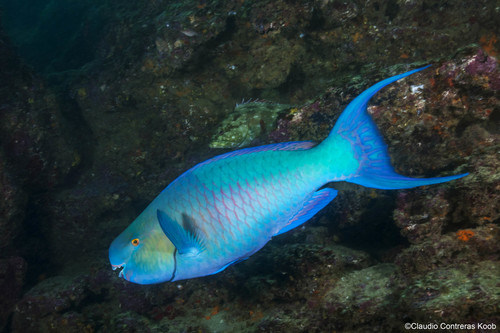
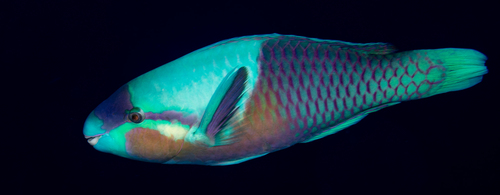
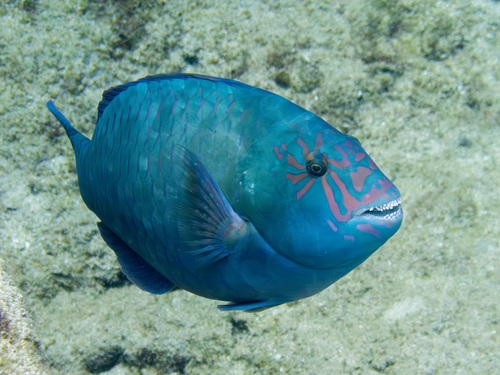
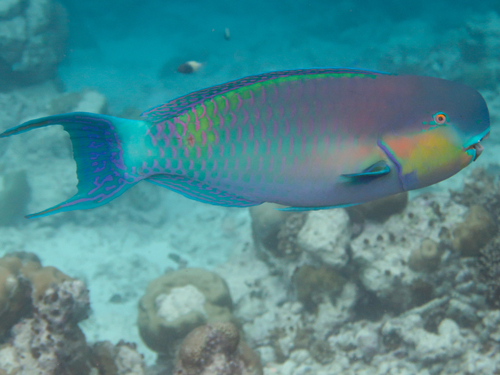
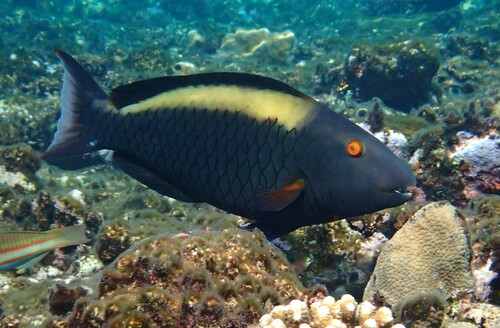
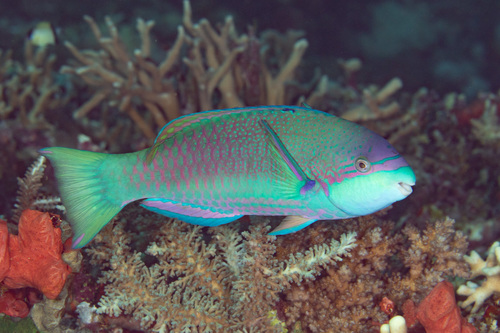
Scarus globiceps, commonly called the globehead, violet-lined, speckled, or roundhead parrotfish, is a species of marine fish that inhabits coral reefs in the Indian and Pacific Oceans. It was first described in 1840 by French naturalist Achille Valenciennes. This species was the first parrotfish collected by Charles Darwin; he gathered specimens from waters around Tahiti and the Cocos Islands. Leonard Jenyns described the Tahitian specimen as a new, separate species named Scarus lepidus, while the Cocos Islands specimen was confirmed to be Scarus globiceps. In 1900, Henry Weed Fowler described a specimen from Caroline Island as Scarus pronus, a name that was later synonymised with Scarus globiceps. The globehead parrotfish can reach a maximum length of 45 cm (18 in) and a maximum weight of 0.5 kg (1.1 lb). Terminal-phase adult males have a mostly green body, with salmon-pink borders on each scale. Their tail fin is green with salmon-pink bands. A horizontal pink band bordered in green runs from the snout, through the eyes, to the end of the opercle. They have 1 or 2 canine teeth on both the upper and lower tooth plates. Initial-phase individuals are grey-brown, with three white bands on their abdomens. The species' range extends from the Society and Line Islands in the Pacific westward; it reaches as far north as the Ryukyu Islands, as far south as the Great Barrier Reef, and stretches across the Indian Ocean to east Africa. It is most common on outer reefs, but can also be found in lagoons. It typically occurs at depths around 12 metres (39 ft), and can occasionally be found as deep as 30 metres (98 ft). Scarus globiceps is harvested as a food fish in Guam.