About Scarabaeus sacer Linnaeus, 1758
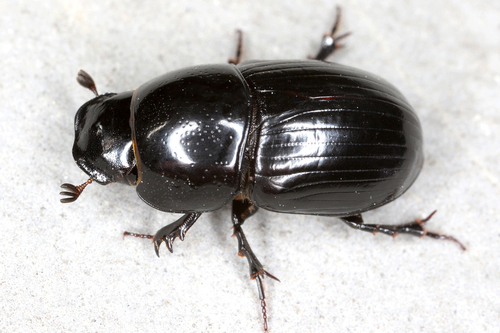
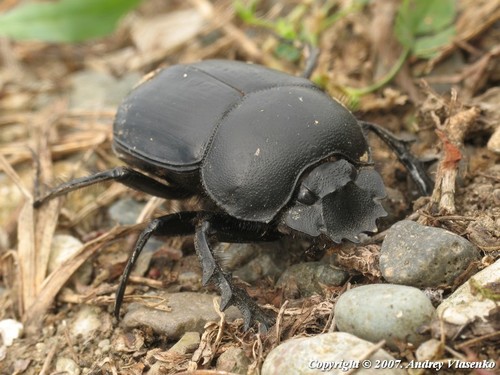
Scarabaeus sacer Linnaeus, 1758 is a robust, entirely black beetle, with adult individuals measuring 1.9–4.0 cm (0.7–1.6 in) in length. Its head has a distinct set of six ray-like projections. These six projections match four more projections on each of its front leg tibiae, forming a total arc of 14 "rays" that can be seen in illustrations. These projections are adaptations that help the species dig and shape dung balls. Unlike the front legs of dung beetles from most other genera, and like other species in the Scarabaeus genus, the front legs of S. sacer are unusual: they do not end in a distinct tarsus, the foot structure that bears claws. The species only has a vestigial claw-like structure, which may provide some help during digging. While the midlegs and hindlegs of Scarabaeus sacer have normal, well-developed, five-segmented tarsi, the front legs are specially adapted for excavation and forming dung balls. This species is found in southern Europe, northern Africa, and western Asia. It has been officially recorded in Afghanistan, Albania, Armenia, Azerbaijan, Bulgaria, Cyprus, Egypt, Eritrea, Ethiopia, France (including Corsica), Greece, Hungary, Iran, Iraq, Israel, Italy (including Sardinia and Sicily), Jordan, India (Kashmir), Libya, Mauritania, Montenegro, Morocco, Palestine, Pakistan, Romania, Portugal, southernmost Russia, Saudi Arabia, Serbia, Spain, Sudan, Syria, Turkey, Turkistan, and Ukraine. Across most of its European range, S. sacer occurs in coastal areas near the Mediterranean and Black Seas, where it often lives in dunes and marshes. For example, in the Camargue, it is found almost exclusively in coastal dunes and coastal marshes. Among coprophagous (dung-feeding) beetles, Scarabaeus sacer is a typical telecoprid: a species that collects dung into balls. An individual will roll its dung ball to a suitable location, dig an underground chamber, hide the ball inside, and consume it over a period of several days. When a female is ready to breed, she chooses particularly fine-textured dung to create her breeding ball, and digs an especially large and deep chamber to hold it. Inside the chamber, she sculpts the dung ball into a pear shape, with a hollow cavity in its narrow end. She lays a single large egg into this cavity, then seals the cavity and leaves to repeat the process in a new location. A successful female S. sacer typically produces only around half a dozen offspring over her lifetime. After the egg hatches, the larva feeds on the stored dung ball. Scarabaeus sacer acts as a host for the phoretic mite Macrocheles saceri.