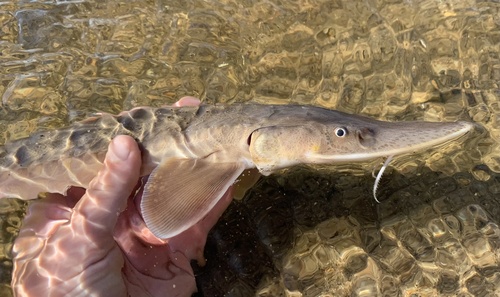
About Scaphirhynchus platorynchus (Rafinesque, 1820)
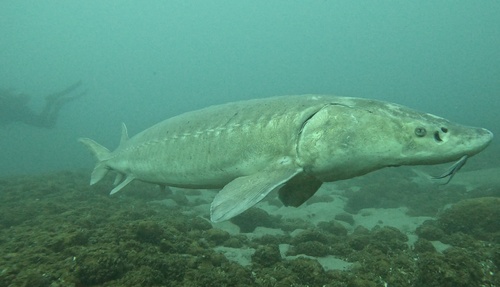
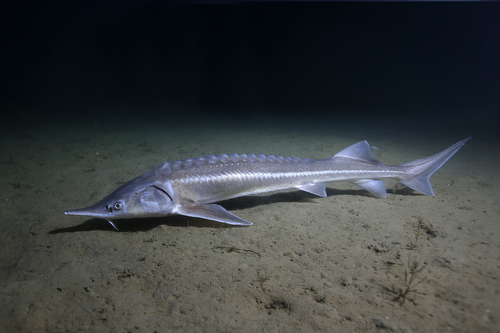
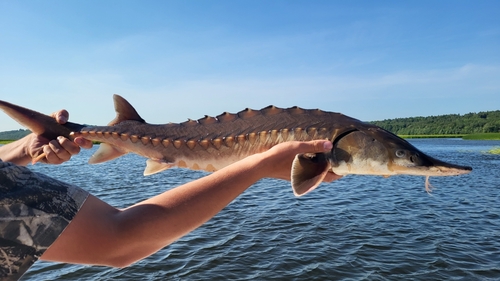
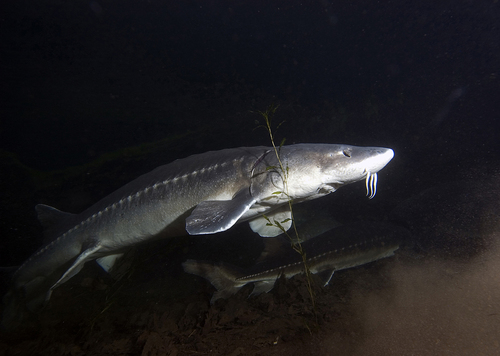
Scaphirhynchus platorynchus, commonly called the shovelnose sturgeon, belongs to the sturgeon family Acipenseridae. All Acipenseridae sturgeons have bony scutes along their sides and back, plus four barbels on the underside of their rostrum. Currently, 25 living sturgeon species are recognized, with 17 in the genus Acipenser. Sturgeons have a holarctic distribution across the northern part of the Northern Hemisphere, and include marine, freshwater, and anadromous species. All sturgeons, including shovelnose sturgeon, are highly valued for their flesh and roe, which is used to make premium caviar. Shovelnose sturgeon can reach 1 metre (39 inches) in length and up to 4.8 kilograms (11 pounds) in weight, but sizes of 50–85 centimetres (20–33 inches) and 2.5 kilograms (5.5 pounds) are far more common. Its scientific name comes from Greek: Scaphirhynchus means "spade snout", and platorynchus means "broad snout". This species has a bill-like, flattened, shovel-shaped rostrum (modified snout). It has four fringed barbels on the ventral side of the rostrum arranged in a straight line that is equally distant from the mouth opening to the tip of the snout; this arrangement differs from that of the pallid sturgeon. Shovelnose sturgeon also have scale-like plates covering their bellies, which distinguishes them from pallid sturgeon, whose bellies are mostly scaleless. Their coloration ranges from light brown to buff, with a white belly. Shovelnose sturgeon are found in the Missouri River and Mississippi River systems, which naturally carry high sediment loads, and they are barely impacted by water turbidity. This species inhabits open main channel areas of large rivers, living close to the bottom, most often in sections with swift current and sand or gravel substrates. Like many river-dwelling fish species, shovelnose sturgeon do not have a restricted home range and may travel long distances. They are bottom feeders that use their highly protrusible mouth to suck up food. Their diet consists mainly of aquatic insect larvae, primarily mayflies, true flies (Diptera), and caddisflies. They also feed on crustaceans, worms, and small fish. As a result of their bottom-feeding behavior, shovelnose sturgeon act as hosts for the glochidia (larvae) of several freshwater mollusc species, including pimpleback (Quadrula pustulosa), hickorynut (Obovaria olivaria), and yellow sandshell (Lampsilis teres). It is the only known host for the hickorynut mussel. Like most sturgeons, shovelnose sturgeon migrate from their feeding grounds to breeding grounds in large rivers. During spawning, their behavior changes, and they swim near the water surface. Females do not spawn every year, and their spawning schedule is not well understood. Spawning occurs over gravel substrate in fairly swift water. Eggs hatch after 3 to 5 days, and the resulting larvae (about 1 cm long) drift downstream to appropriate river rearing areas. Shovelnose sturgeon grow relatively slowly, reaching 54 cm (21.3 inches) in length by five years of age.