About Scaevola taccada (Gaertn.) Roxb.
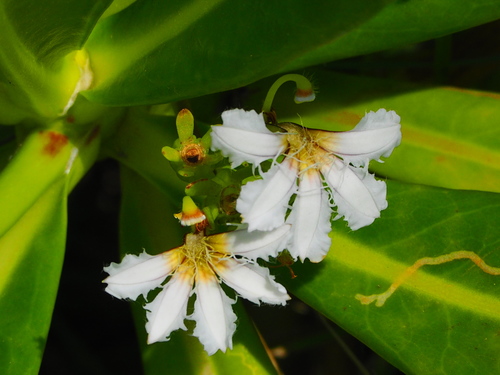
Scaevola taccada (Gaertn.) Roxb. is a large bush that reaches 3 to 10 metres in height. It is characteristic of littoral zones, where it grows very close to the sea, exposed to salt spray, and typically occurs on sandy or pebbly soils. Its branchlets are 1 to 1.5 centimetres thick, with white tufts at the leaf axils. Its leaves are slightly succulent, measuring 8 to 25 centimetres long. They grow in a closely alternate or spiral arrangement, and are crowded at the tips of stems. The leaves are glabrous, with a fleshy-looking yellowish green color.
This species is distributed across coastal areas and beaches of Okinawa, Taiwan, Southern China, Vietnam, Malaysia, Philippines, Indonesia, East Timor, Northern Australia, Polynesia, Melanesia, Micronesia, East Africa, Madagascar, Mauritius, Seychelles, Oman, Yemen, India, Maldives, Burma, Thailand, Cambodia, Chagos Islands, Comoros, and Réunion. In the United States (Florida, Puerto Rico, US Virgin Islands), as well as many other Caribbean nations and the Bahamas, Scaevola taccada has become an invasive species, displacing the native Caribbean species Scaevola plumieri from its native habitat.
Scaevola taccada typically grows directly on the beaches of tropical coasts, and prefers beach crests on coral sands. It grows within the salt spray zone, and is one of the first pioneer plant colonisers on tropical atolls and sandbanks. In addition to growing from seeds, it can be easily propagated from cuttings. It prefers well-drained sandy soils, and is a very salt tolerant scrub. However, its roots cannot tolerate frequent direct exposure to rising seawater. It is sometimes found growing in loose plant communities alongside coconut palms, soldierbush, beach morning glory, beach gardenia, several pandanus species, and beach calophyllum, with portia tree, sea almond, beach hibiscus, Cordia subcordata and other species growing further inland. This plant is often featured prominently on tropical island postcards and wallpapers.
On some Pacific islands, Scaevola taccada is used to prevent coastal erosion and for landscaping. It is also planted on beach crests to protect other cultivated plants from salt spray. Mature S. taccada trees create a cool, safe shaded environment for female green turtles that come ashore to lay their eggs. Parts of the plant are also used in traditional Polynesian and Asian medicine. Chamorro breath-hold spearfishermen in the Mariana Islands used sap drops from this plant to treat eye irritation. Historically in the Maldives, the leaves of this plant were often used as famine food.