About Scaevola plumieri (L.) Vahl
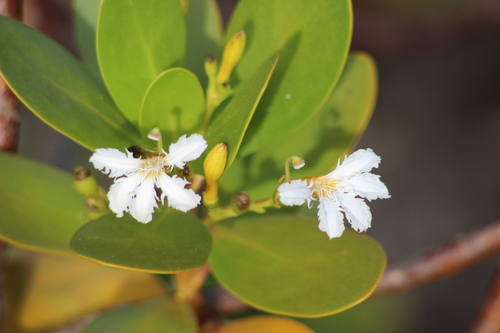
Scaevola plumieri (L.) Vahl is a many-branched evergreen shrub. It produces succulent, hairless leaves at the tips of its branches, and sheds leaves below these growing tips, leaving visible leaf scars on the underlying yellowy-green stems. Leaf axils may have either sparse silky hairs or no hairs at all. Its leaves are either stalkless (sessile) or borne on a winged stalk; they are obovate in shape, 5–11 cm long, 2–7 cm broad, and have smooth edges. Each leaf has 2 to 4 pairs of lateral veins that are not easily visible. The inflorescence consists of a series of axillary cymes, each holding one to seven stalkless flowers. The corolla is white or greenish, with a tube that is 10–12 mm long and 3 mm broad, and is densely covered in hairs on the inside. The ovary has two locules, but only one ovule develops into a seed. The fleshy fruit is blue or black, and measures 10 to 15 mm in diameter. Seeds do not disperse away from the fruit. Scaevola plumieri is similar to Scaevola taccada, and both were originally included within the original circumscription of this species. Unlike related species, S. plumieri has short or completely absent lobes on its calyx and black fruit when ripe. S. sericea has clearly visible calyx lobes and white fruit, with calyx lobes that remain attached to the mature fruit. Scaevola plumieri is distributed along the east African coast from Somalia to South Africa, the west African coast from São Tomé to Angola, Ceylon, and tropical America south of Florida. It grows in coastal sand dune habitats.