About Scaeva pyrastri (Linnaeus, 1758)
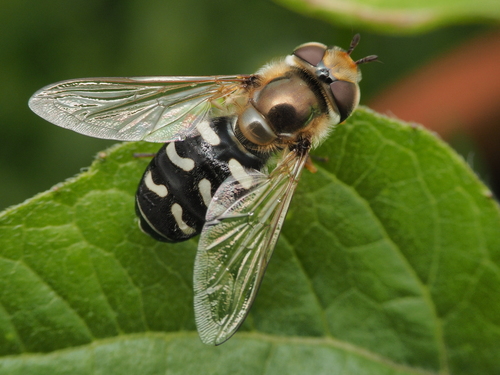
Scaeva pyrastri (Linnaeus, 1758) is a large, distinctive hoverfly that reaches an adult length of 11–15 millimetres (0.43–0.59 in). Adults have three pairs of white comma-shaped lunule markings on the abdomen; in the closely related species Scaeva selenitica, these markings are yellow instead. This species has a yellow face, reddish-brown antennae, and hairy eyes. The scutellum is brown-yellow, and the legs are red with black femur bases. Male S. pyrastri have eyes that meet at the center of the frons, while female eyes are separated. Larvae are light green, or occasionally pink, with a white longitudinal stripe along their back. This hoverfly species occurs across most of Europe, the Near East, the East Palearctic realm, the Nearctic realm, North Africa, and the Indomalayan realm. In the United Kingdom, S. pyrastri is a migrant species that arrives in large numbers some years and is nearly absent in others. It lives in gardens, meadows, and wastelands. Adult S. pyrastri frequently visit flowers of Apiaceae, also known as Umbelliferae, as well as flowers of rape, honeysuckle, and daisies. Adults fly from April to September, with activity peaking in July and August. Larvae feed on a variety of aphid species, and a single larva may consume more than 500 aphids over its larval development.