About Scadoxus multiflorus (Martyn) Raf.
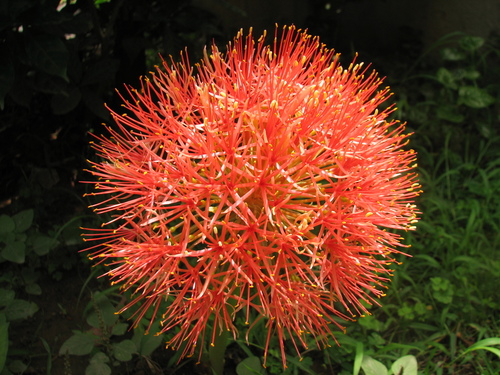
Scadoxus multiflorus (Martyn) Raf. grows from a rhizomatous bulb, which is a bulb that also produces rhizomes, modified underground stems. Its leaves and flowers may emerge at the same time, or leaves may develop after flowers. The bases of the leaves (called petioles or stalks) are tightly wrapped together to form a false stem, or pseudostem, that is 5 to 60 cm (2 to 24 in) long. Flowers grow in an umbel shaped cluster at the top of a leafless stem called a scape, which is 12 to 75 cm (5 to 30 in) long. Both the pseudostem and scape are often covered with spots that range from reddish brown to dark violet. The bracts located under the umbel wither quickly. The umbel is roughly globe-shaped and holds between 10 and 200 individual flowers. Each flower has a stalk, or pedicel, that is typically 15 to 45 mm (0.6 to 1.8 in) long. The tepals, stamen filaments, and style are all scarlet, fading to pink as they age. The bases of the tepals fuse together to form a cylindrical tube 4 to 26 mm (0.2 to 1.0 in) long; the free outer ends of the tepals are 12 to 32 mm (0.5 to 1.3 in) long, narrow, and spreading. The fruit is a berry 5 to 10 mm (0.2 to 0.4 in) across. Three subspecies of Scadoxus multiflorus are accepted; Friis and Nordal have summarized the differences between them. While their size ranges mostly overlap, the ratio of flower tube length to the length of the free tepal segments distinguishes the subspecies. In S. m. subsp. longitubus, the tube and free segments are roughly the same length. In S. m. subsp. multiflorus, the tube is generally shorter than the free segments, and S. m. subsp. katherinae falls between the two. S. m. subsp. multiflorus typically has narrower free tepal segments than the other two subspecies. S. m. subsp. katherinae is the tallest, S. m. subsp. longitubus is the shortest, and S. m. subsp. multiflorus is generally intermediate in height, though it varies across its large range. The species is native to tropical and southern Africa, and parts of the Arabian Peninsula. S. m. subsp. multiflorus is found throughout southern Africa. S. m. subsp. longitubus grows across tropical West and Central Africa, including Cameroon, Ghana, Ivory Coast, Liberia, and Sierra Leone. S. m. subsp. katherinae is native to Mediterranean climate forest, scrub, and woodland in eastern southern Africa, specifically Cape Province and KwaZulu-Natal in South Africa, and Swaziland. Scadoxus multiflorus grows primarily in moist, shady habitats, including savannah woodlands, and forests along rivers and in mountain areas. Some species in the genus Scadoxus are strongly toxic, containing poisonous alkaloids that are lethal to grazing animals such as sheep and goats that eat the leaves or bulbs. In parts of tropical Africa, Scadoxus multiflorus is traditionally used as an ingredient in arrow poisons and fishing poisons. It is also used in traditional medicine, though it is used less often for this purpose in South Africa than Scadoxus puniceus. Scadoxus multiflorus is sensitive to cold. Forms originating from southern Africa require a minimum temperature of 5 °C (41 °F), while tropical forms need a minimum of 10 °C (50 °F) or higher. It is recommended to grow this species in an open, well-drained growing medium that is mostly organic. It is propagated by seed. It is affected by the same pests that affect other Scadoxus species generally. Scadoxus multiflorus subsp. longitubus is rarely, if ever, cultivated, though it was recorded as being introduced in 1877 under its synonym Haemanthus mannii. Scadoxus multiflorus subsp. multiflorus is produced for sale in large quantities by the Dutch horticultural industry. In cultivated plants, flowers often emerge before leaves, and sometimes do not appear until late summer. Scadoxus multiflorus subsp. katherinae has been described as imposing, sometimes reaching 120 cm (4 ft) in height, with a prominent purple-spotted pseudostem. It can produce red berries that may last through the winter. The UK National Plant Collection for Scadoxus notes it is an excellent plant for a glasshouse or sunny windowsill. In South Africa, it can be grown outdoors in shade, in well-drained, light soil that contains plenty of organic matter. It needs ample water when actively growing, but requires good drainage during its dormant period. It will grow under trees as long as the soil is sufficiently fertile.