About Sayornis saya (Bonaparte, 1825)
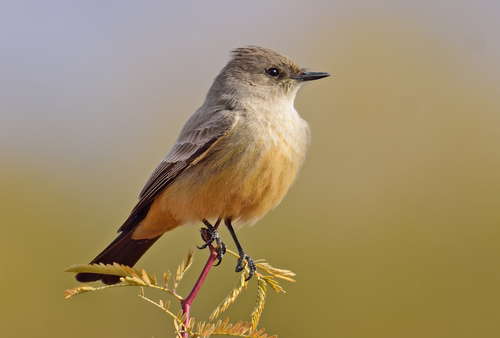
Say's phoebe (scientific name Sayornis saya (Bonaparte, 1825)) is a barrel-chested bird with a squared-off head. Adult plumage is gray-brown on the upper body, with a black tail and buffy cinnamon underparts that become more orange around the vent. The tail is long, and when the bird is resting, the primary flight feathers end just past the rump. In flight, the wings appear pale and look similar to the wings of a female mountain bluebird. Juveniles are similar in appearance to adults, but have buffy orange to whitish wingbars and a yellow gape. Adult Say's phoebes measure 7.5 inches (19 cm) in length, have a wingspan of 13 inches (33 cm), and weigh 0.75 ounces (21 g).
Say's phoebes live year-round in a range that extends from western Colorado southwest to southern California, east to the western panhandle of Texas, and south through western Mexico. Their breeding range stretches from Alaska south through western and south central Canada, then continues south through North Dakota and the midwestern United States to New Mexico and westward. They winter from the desert southwestern United States to southern Texas, and south through Mexico to northern Central America. During migration, individuals can be found thousands of miles outside their normal range, with regular fall sightings reported in New England (U.S.) and Nova Scotia (Canada). These birds prefer dry, desolate, arid landscapes, and can be found on farmland, savanna, and open woodlands, usually near water. They tend to be early migrants to the western United States.
In behavior and ecology, Say's phoebe is similar to the eastern phoebe. It leaves its perch to sally out and catch insects in mid-air, and also hovers in a manner similar to an American kestrel, dipping its tail while perched. Say's phoebe often feeds just above the water's surface. They eat almost exclusively insects, but have also been recorded eating berries. They nest in the typical fashion of phoebes, attaching their nests under bridges, on canyon walls, in wells, and in abandoned mine shafts. The cup-shaped nest is built by the female from grass, forbs, moss, and plant fibers, lined with hair and other fine materials. The female lays three to seven (usually four or five) mostly unmarked white eggs; some eggs have red spots. The eggs are roughly 0.8 inches (20 mm) in size.
The diet of Say's phoebe is primarily insects, including grasshoppers, flies, crickets, beetles, and bees, though experts dispute whether honey bees are actually a suitable part of their diet. They catch prey either by taking it mid-air or by pouncing on insects while they are on the ground. They have also been observed eating small fish. The diet of adult Say's phoebes differs from that of nestlings; nestlings consume a higher proportion of soft foods.