About Saxifraga oppositifolia L.
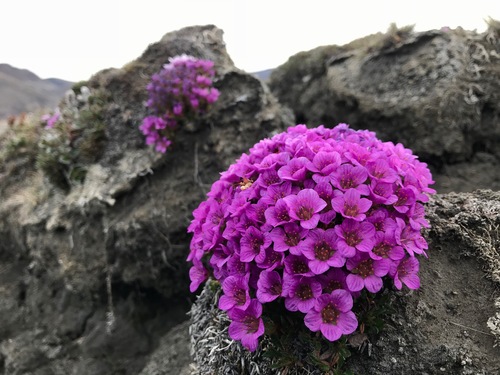
Saxifraga oppositifolia L. is a low-growing plant that forms dense or loose mats, reaching up to 5 cm (2 in) in height. It has somewhat woody creeping or trailing branches that grow close to the ground surface. Its small leaves are rounded, scale-like, arranged oppositely in four rows, and have ciliated margins. Flowers are solitary, borne on short stalks, and reach about 1 cm (1⁄2 in) in diameter. Petals are purple or lilac, and are much longer than the calyx lobes. This species is one of the first plants to flower in spring, and will continue blooming through the entire summer in areas where snow melts later. Saxifraga oppositifolia grows in a wide range of cold temperate to Arctic habitats, and is generally found from sea level up to 1,000 m (3,300 ft), where it often colours the surrounding landscape. Its native habitats include tundra, arctic coastal bluffs, alpine scree, and rock crevices. Swiss botanist Christian Körner recorded the species growing at 4,505 m (14,780 ft) in the Swiss Alps, making it the highest elevation angiosperm in Europe. It has even been recorded growing on Kaffeklubben Island in northern Greenland at 83°N 40°E, which is the most northerly location where any vascular plant grows in the world. This species is a popular plant for alpine gardens, though it is difficult to grow in warm climates. Its edible flower petals are eaten, particularly in parts of Nunavut that do not have abundant berries. Petals taste bitter at first, then become sweet, and are slightly sticky. The Inuit know this plant as aupilaktunnguat. Its leaves and stems are brewed to make herbal tea; according to many Nunavummiut, the tea is best harvested later in the season, after the flowers have died. Saxifraga oppositifolia is the territorial flower of Nunavut, Canada, a symbolic flower of Nordland county, Norway, and the county flower of County Londonderry, Northern Ireland.